
TCS NQT Interview Questions and Answers (2025 - 2026): The Complete Preparation Guide
The ultimate comprehensive guide to cracking the Tata Consultancy Services National Qualifier Test (TCS NQT) technical, coding, managerial, and HR interview rounds for Ninja, Digital, and Prime career tracks.
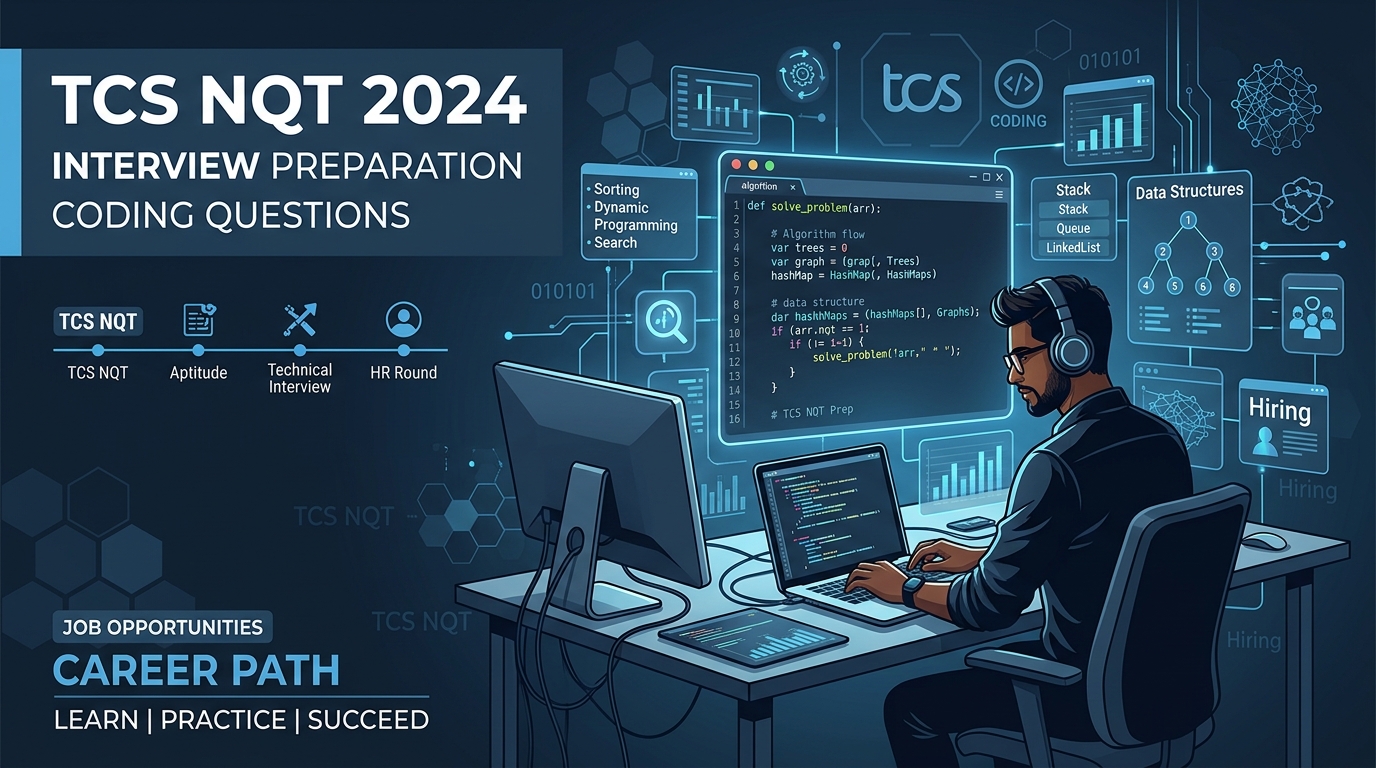
Every year in India, over 300,000 engineering and science graduates from Tier-1, Tier-2, and Tier-3 institutions compete in the TCS National Qualifier Test (NQT). As India's largest IT services and consulting employer, Tata Consultancy Services conducts NQT as the standardized benchmark to select entry-level software talent across three distinct career tracks: TCS Ninja, TCS Digital, and the prestigious TCS Prime cadre.
While clearing the online computer-based cognitive assessment is the initial hurdle, more than 60% of test qualifiers get eliminated during the face-to-face Technical and Managerial interview rounds. Candidates frequently stumble not because of a lack of theoretical memorization, but because they struggle to articulate clean code logic, core CS fundamentals, and situational problem-solving under real-time scrutiny.
This in-depth guide covers verified TCS NQT interview questions, real coding challenges with step-by-step logic, core computer science concepts (OOPs, DBMS, SQL, OS, Computer Networks), managerial case studies, and winning HR strategies to secure your offer letter.
- 1. TCS NQT Structure: Ninja vs Digital vs Prime Profiles
- 2. TCS NQT 2025/2026 Complete Selection Pipeline
- 3. Core Technical Questions: Object-Oriented Programming (OOP)
- 4. Core Technical Questions: Data Structures & Algorithms (DSA)
- 5. Core Technical Questions: DBMS & Real SQL Interview Queries
- 6. Core Technical Questions: Operating Systems & Computer Networks
- 7. Real TCS NQT Coding Questions with Multi-Language Solutions
- 8. TCS Managerial Round (MR) Questions & STAR Method
- 9. TCS HR Round Questions & Strategic High-Impact Answers
- 10. Pro Strategies to Upgrade from Ninja to Digital or Prime
- 11. Top 10 Mistakes That Disqualify Freshers in TCS Interviews
- 12. Frequently Asked Questions (FAQ)
1. TCS NQT Structure: Ninja vs Digital vs Prime Profiles
When you register for the TCS NQT in India, your performance in the online test dictates which interview track you are invited to attend. In the 2025/2026 hiring cycle, TCS segments candidates into three distinct compensation bands:
| Category | Annual CTC (Approx.) | Interview Focus | Expected Technical Depth |
|---|---|---|---|
| TCS Ninja | ₹3.36 LPA – ₹3.60 LPA | Basic programming, fundamental OOPs, basic SQL, college project discussion. | Entry-level familiarity with C++, Java, or Python; understanding of basic loops and arrays. |
| TCS Digital | ₹7.00 LPA – ₹7.50 LPA | Advanced DSA, Dynamic Programming, System Design basics, Cloud, Microservices, and AI/ML awareness. | High-level algorithmic thinking; ability to write optimal time-complexity solutions without built-in library shortcuts. |
| TCS Prime | ₹9.00 LPA – ₹11.50 LPA | Competitive programming, Distributed systems fundamentals, advanced database internals, Cloud native architectures. | Elite algorithmic mastery, deep knowledge of system trade-offs, concurrency, and real-world deployment experience. |
2. TCS NQT 2025/2026 Complete Selection Pipeline
The recruitment pipeline is structured into distinct qualifying rounds designed to assess both intellectual aptitude and engineering competencies:
- Online Cognitive Assessment: Includes Numerical Ability, Verbal Ability, and Reasoning Ability. This evaluates mental sharpness, speed, and analytical reasoning.
- Advanced Technical Assessment: Includes Advanced Quantitative & Reasoning sections, along with hands-on Coding problems (usually 2 problems: 1 easy-to-medium and 1 medium-to-hard).
- Technical Interview (TR): A 30 to 45-minute technical evaluation covering programming languages, data structures, database design, system fundamentals, and your academic capstone projects.
- Managerial Round (MR): Scenario-based questions that test cultural fit, ethical decision-making, pressure tolerance, and real-time collaboration.
- Human Resources Round (HR): Verification of credentials, relocation willingness, night shift flexibility, and communication skills.
3. Core Technical Questions: Object-Oriented Programming (OOP)
Object-Oriented Programming is the cornerstone of almost every TCS technical interview. Expect the panel to test your grasp on theoretical definitions paired with practical code implementations.
The four core pillars are:
- Encapsulation: Bundling data (variables) and the methods that operate on that data into a single unit (class) while restricting direct outside access via private access modifiers. Example: A BankAccount class where the balance variable is private and only modified through deposit() and withdraw() methods with validation.
- Abstraction: Hiding internal implementation complexities and exposing only the essential interface to the user. Example: Pressing an accelerator in a car without needing to understand fuel injection mechanics; in software, an interface or abstract class.
- Inheritance: The mechanism by which a child class inherits state and behaviors from a parent class, promoting code reusability. Example: A base class `Employee` inherited by `Developer` and `Manager`.
- Polymorphism: The ability of an entity to take multiple forms. It is divided into Compile-time Polymorphism (Method Overloading) and Runtime Polymorphism (Method Overriding via virtual functions).
| Parameter | Method Overloading | Method Overriding |
|---|---|---|
| Binding Type | Compile-time (Static binding) | Run-time (Dynamic binding) |
| Class Scope | Occurs within the same class | Occurs between Parent and Child classes |
| Method Signature | Must have different parameters (type, number, order) | Must have identical name and parameter list |
| Return Type | Can be the same or different | Must be identical (or covariant) |
A Virtual Function is a member function in a base class that is declared with the virtual keyword and overridden in a derived class. When accessed through a base class pointer or reference, the call is dispatched dynamically at runtime based on the actual object type using a VTABLE (Virtual Table) and VPTR (Virtual Pointer).
A Pure Virtual Function is a function that has no implementation in the base class and is assigned = 0 (e.g., virtual void calculate() = 0;). Any class containing at least one pure virtual function becomes an Abstract Class and cannot be instantiated directly.
An Abstract Class can have both abstract methods (without bodies) and concrete methods (with default implementations), as well as instance variables, constructors, and various access modifiers (private, protected).
An Interface (in Java/C#) represents a pure contract. Traditionally, it only contains method declarations (all implicitly public and abstract) and constant variables (public static final). While modern Java (Java 8+) allows default and static methods in interfaces, a class can implement multiple interfaces (achieving multiple inheritance), but can extend only one abstract class.
4. Core Technical Questions: Data Structures & Algorithms (DSA)
Interviewers at TCS frequently evaluate your intuition regarding memory allocation, traversal speeds, and time complexity tradeoffs.
Use a Linked List when:
- Frequent insertions and deletions at arbitrary positions are required in \(O(1)\) time (provided the node pointer is known).
- The exact number of elements is dynamic or unknown ahead of time, preventing memory reallocation overhead.
Use an Array when:
- Random access by index is required in \(O(1)\) time.
- Memory cache locality is critical (arrays occupy contiguous memory blocks, leading to fewer CPU cache misses).
- Memory overhead per element must be minimized (linked lists require extra memory for pointers).
Floyd's algorithm determines if a linked list contains a cycle using two pointers traversing the list at different speeds:
- Initialize two pointers:
slowandfast, both starting at the head. - Advance
slowby 1 step (slow = slow->next) andfastby 2 steps (fast = fast->next->next) in each iteration. - If there is no cycle,
fastorfast->nextwill reachNULL(\(O(N)\) time, \(O(1)\) auxiliary space). - If a cycle exists,
fastwill eventually catch up and meetslowinside the loop.
- Pre-order (Root → Left → Right): Used to clone trees or construct prefix expressions.
- In-order (Left → Root → Right): When executed on a Binary Search Tree (BST), visits nodes in ascending sorted order.
- Post-order (Left → Right → Root): Used for bottom-up operations like deleting trees or evaluating postfix expressions.
- Level-order (Breadth-First Search): Explores nodes level by level using a Queue data structure.
Quicksort has an average time complexity of \(O(N \log N)\) and worst-case of \(O(N^2)\). It is an in-place sorting algorithm with \(O(\log N)\) auxiliary stack space, making it preferred for arrays due to cache performance.
Mergesort has guaranteed \(O(N \log N)\) time complexity across best, average, and worst cases, but requires \(O(N)\) auxiliary memory for arrays. However, Mergesort is preferred for Linked Lists because nodes can be re-linked in \(O(1)\) space without allocating contiguous auxiliary memory buffers.
5. Core Technical Questions: DBMS & Real SQL Interview Queries
Relational database management and SQL queries are guaranteed topics in any TCS technical round. Expect live queries written on paper or shared via virtual codepads.
Consider transferring ₹5,000 from Account A to Account B:
- Atomicity ("All or Nothing"): Either the ₹5,000 is debited from A and credited to B completely, or no changes occur at all if the system crashes midway.
- Consistency: The database must transition from one valid state to another. The total money across both accounts before and after the transaction must remain identical.
- Isolation: Concurrent transactions execute without interfering with one another. Another query reading Account A's balance cannot view an intermediate half-updated balance.
- Durability: Once the transaction commits, the updated balance persists permanently in non-volatile storage, even during sudden power failure.
This is the single most commonly asked SQL query in Indian IT interviews. Here are the two standard approaches:
Pro Tip: Mentioning DENSE_RANK() instead of LIMIT 1 OFFSET 1 shows the interviewer that you understand how duplicate highest salaries are properly handled.
WHEREfilters individual records before any aggregations or groupings are calculated. It cannot be used with aggregate functions likeSUM(),AVG(), orCOUNT().HAVINGfilters aggregated groups after theGROUP BYclause has been executed. It is used explicitly with aggregate expressions (e.g.,HAVING COUNT(*) > 5).
Normalization is the process of structuring a relational database to reduce data redundancy and eliminate update, insertion, and deletion anomalies:
- 1NF (First Normal Form): Each table cell must contain atomic (single-valued) entries, and all records must be uniquely identifiable.
- 2NF (Second Normal Form): Table is in 1NF and contains no partial functional dependencies (all non-key attributes are fully functionally dependent on the entire primary key).
- 3NF (Third Normal Form): Table is in 2NF and contains no transitive functional dependencies (non-key attributes do not depend on other non-key attributes).
- BCNF (Boyce-Codd Normal Form): A stricter version of 3NF where for every functional dependency \(X \rightarrow Y\), \(X\) must be a super key.
6. Core Technical Questions: Operating Systems & Computer Networks
A Process is an executing instance of a computer program that possesses its own dedicated address space, memory heap, and system resources. Context switching between processes is relatively expensive.
A Thread is the smallest sequence of programmed instructions that can be managed independently by an OS scheduler, often called a lightweight process. Multiple threads within the same process share the same code segment, data segment, and OS resources, but maintain their own independent call stack and registers. Context switching between threads is significantly faster.
A deadlock situation can only arise if all four conditions hold simultaneously:
- Mutual Exclusion: At least one resource must be held in a non-shareable mode.
- Hold and Wait: A process must be holding at least one resource and requesting additional resources held by other processes.
- No Preemption: Resources cannot be forcibly seized from a process; they can only be released voluntarily upon task completion.
- Circular Wait: A closed chain of processes exists such that each process holds a resource that is requested by the next process in the cycle.
The Transmission Control Protocol (TCP) establishes a reliable, full-duplex connection between client and server via three steps:
- SYN: The client sends a packet with the SYN (Synchronize Sequence Number) flag set and an initial sequence number \(x\) to the server.
- SYN-ACK: The server acknowledges receipt by sending back a packet with the SYN and ACK flags set, acknowledging \(x+1\) and sending its own sequence number \(y\).
- ACK: The client sends an ACK packet back confirming receipt of sequence number \(y+1\). The connection is now established and data transmission begins.
A classic full-stack question assessing end-to-end understanding:
- URL Parsing: The browser parses the protocol (HTTPS), hostname (www.tcs.com), and default port (443).
- DNS Resolution: Browser checks browser cache → OS cache → router cache → ISP DNS resolver to translate hostname to IP address.
- TCP Connection & TLS Handshake: A 3-way TCP handshake is completed, followed by a TLS/SSL handshake to negotiate encryption ciphers and verify the SSL certificate.
- HTTP Request & Response: Browser sends an HTTP
GETrequest; the web server processes it and responds with HTML status 200 OK. - Rendering Engine: Browser parses HTML to build the DOM tree, CSS to build the CSSOM tree, executes JavaScript, and paints the layout onto the screen.
7. Real TCS NQT Coding Questions with Multi-Language Solutions
In both the advanced NQT online test and the technical interview, candidates are asked to write clean code, handle edge cases, and describe the time and space complexity. Here are four verified, high-frequency coding problems:
Problem Statement: Given a string s containing lowercase English characters, find the first non-repeating character and return its index. If all characters repeat, return -1.
Optimal Complexity: Time Complexity: \(O(N)\) | Auxiliary Space: \(O(1)\) (Since the alphabet is bounded to 26 characters).
Problem Statement: Given an integer array nums, find the contiguous subarray (containing at least one number) which has the largest sum and return its sum.
Optimal Complexity: Time: \(O(N)\) | Auxiliary Space: \(O(1)\)
Problem Statement: Given a string s containing just the characters '(', ')', '{', '}', '[' and ']', determine if the input string is valid.
Optimal Complexity: Time: \(O(N)\) | Space: \(O(N)\) using a Stack.
8. TCS Managerial Round (MR) Questions & STAR Method
The Managerial Round bridges technical knowledge and real-world project execution. The interviewer is typically a Senior Project Manager or Delivery Lead looking for emotional maturity, project ownership, and team chemistry.
- S — Situation: Set the context with specific project constraints or team dynamics.
- T — Task: Define the objective or challenge you needed to overcome.
- A — Action: Explain the exact technical or interpersonal steps you took.
- R — Result: Share quantifiable outcomes, lessons learned, and the final impact.
Recommended Strategy:
"First, I would remain calm and triage the severity of the bug. If the bug causes data loss, a security vulnerability, or crashes primary customer flows, I would immediately notify my project lead to pause deployment. Next, I would isolate the faulty commit, test a rollback plan, and reproduce the issue locally with debug logs. Once fixed and tested through automated regression checks, we would re-deploy. Clear communication with stakeholders is always prioritized over shipping broken software."
Recommended Strategy:
"I never make code reviews personal. I base all review comments on established engineering benchmarks—such as time complexity, maintainability, clean architecture, and project coding standards. If a disagreement persists, I invite the teammate to a 5-minute video sync to understand their perspective. If we still reach an impasse, we refer to documentation or consult a senior technical architect to make an objective determination."
9. TCS HR Round Questions & Strategic High-Impact Answers
The HR round at TCS is not just a formality; it is a critical screening stage where candidates can be eliminated due to hesitation regarding policies, shifts, or relocation.
Follow the Present → Past → Future formula:
"Good morning! I am an engineering graduate in Computer Science from [College Name]. Recently, I built a [Project Name], which is a web application using React, Python, and PostgreSQL that solved [Problem]. During my academic journey, I worked consistently on Data Structures and object-oriented design, solving over 250 problems on competitive platforms. Outside coursework, I completed an internship where I learned Agile methodologies and CI/CD workflows. I am excited to begin my professional career with Tata Consultancy Services because of your global exposure, learning ecosystem, and ethical leadership."
"Tata Consultancy Services is recognized globally for its resilience, ethical governance, and the immense breadth of its enterprise client portfolio. Furthermore, the Initial Learning Program (ILP) at TCS Trivandrum is regarded as the gold standard in fresher corporate training. As someone eager to specialize in scalable enterprise software and cloud architectures, being part of the Tata Group provides long-term stability and unmatched learning opportunities."
- "Are you open to relocating anywhere in India?" Always answer with an unambiguous "Yes, absolutely." TCS operates major delivery centres across Chennai, Pune, Bengaluru, Hyderabad, Kolkata, Mumbai, Delhi-NCR, Kochi, and Ahmedabad. Stating geographic limitations during campus recruitment is a frequent cause of rejection.
- "Are you willing to work in night shifts or 24/7 rotational shifts?" Answer "Yes." Global delivery requires supporting international time zones (US, Europe, APAC).
- "Do you have any active backlogs?" Be completely truthful. TCS policy requires all academic backlogs to be cleared before joining.
10. Pro Strategies to Upgrade from Ninja to Digital or Prime
If you are currently allocated to the Ninja band, you can convert your interview into a Digital (₹7 LPA) or Prime (₹9–11.5 LPA) offer by executing these key strategies:
- Write Clean, Production-Grade Code: Avoid single-letter variable names (e.g., use
totalSalaryinstead ofs). Include boundary checks for null, empty arrays, and integer overflow. - State Time and Space Complexity Proactively: Immediately after writing a solution, explain: "This solution runs in \(O(N \log N)\) time due to sorting and consumes \(O(1)\) auxiliary memory."
- Discuss Real System Architecture: Highlight personal projects hosted on cloud platforms (AWS, Azure, Docker, Kubernetes). Mentioning REST APIs, caching layers (Redis), or database indexing demonstrates senior-level initiative.
- Participate in TCS Hackathons: Excelling in TCS CodeVita or InfyTQ qualifies candidates directly for Prime and Digital interview tracks.
11. Top 10 Mistakes That Disqualify Freshers in TCS Interviews
- Faking Project Experience on Resume: Interviewers dig deep into project architecture. Claiming full ownership of a group project without knowing how the database was modeled leads to immediate rejection.
- Inability to Write Code by Hand: Practicing only with IDE auto-complete causes panic when asked to write syntax on plain paper or Google Docs.
- Confusing Overloading with Overriding: Mixing up compile-time vs run-time polymorphism signals weak fundamentals.
- Ignoring Non-CS Basics: If you are from Mechanical, Civil, or ECE, failing to explain your branch core subjects alongside software questions signals poor academic commitment.
- Negative Body Language & Poor Audio: For virtual interviews, test your microphone, ensure adequate lighting, and maintain steady eye contact with the webcam.
12. Frequently Asked Questions (FAQ)
Ready to Accelerate Your Software Engineering Career?
Explore more technology insights, architectural case studies, and engineering deep dives from the Codexal team.
Browse All Codexal Tech Articles →