ಭಾರತದಲ್ಲಿ ಫ್ರೆಶರ್ಗಳಿಗೆ IT ಉದ್ಯೋಗಗಳು 2026: ಸಂಬಳ, ಅರ್ಹತೆ, ಆಫ್-ಕ್ಯಾಂಪಸ್ ಡ್ರೈವ್ ಮತ್ತು ಅರ್ಜಿ ಹಾಕುವ ವಿಧಾನ
A complete, practical guide to landing your first IT job in India — which roles are actually hiring freshers in 2026, what each company pays, the eligibility criteria that quietly reject most applications, the off-campus drive calendar, and the exact skills and resume format that get a 2026 or 2027 batch graduate shortlisted.
India adds well over a million engineering, computer applications and science graduates to the job market every year, and the IT sector remains the single largest absorber of that talent. Yet most freshers experience the market as a wall of silence: hundreds of applications on job portals, no replies, and no clear idea whether the problem is the resume, the skills, the eligibility criteria, or simply applying in the wrong place.
It is usually none of the dramatic reasons. The 2026 Indian IT fresher market is structurally different from the 2021–2022 hiring boom. Volume hiring at the large service companies has become selective and assessment-led, Global Capability Centres (GCCs) have become a serious parallel employer, and the skills bar has moved from "knows Java syntax" to "can ship something small, explain it, and work next to AI tooling".
This guide lays out the whole picture: the IT fresher salary in India company by company, eligibility rules including the percentage, CGPA, backlog and gap-year criteria, the off-campus drive calendar for the 2026 and 2027 batches, role-by-role skill roadmaps, how the interview pipeline actually works, work-from-home and government IT options, how to spot a placement scam, and a 90-day plan you can start today.
- 1. IT Jobs in India 2026: What the Hiring Market Actually Looks Like
- 2. The 12 IT Job Roles Hiring the Most Freshers in 2026
- 3. IT Fresher Salary in India 2026: Company-by-Company Table
- 4. Eligibility Criteria: Percentage, CGPA, Backlogs, Gap Years & Branch
- 5. Off-Campus Drive Calendar 2026 - 2027 (Month by Month)
- 6. Where to Apply: Official Career Portals & Job Sites
- 7. The Skills Stack That Actually Gets Shortlisted
- 8. How the Hiring Process Works: Assessment, Technical, Managerial, HR
- 9. Resume & ATS: Why Good Candidates Get Filtered Out
- 10. Work From Home & Remote IT Jobs for Freshers in India
- 11. Government & PSU IT Jobs in India
- 12. Internships, PPOs and the Apprenticeship Route
- 13. City-Wise IT Job Hubs and the Cost-of-Living Reality
- 14. How to Spot a Fake Job Offer or Placement Scam
- 15. Understanding Your Offer: CTC vs In-Hand, Bonds & Service Agreements
- 16. Your 90-Day IT Job Search Plan
- 17. Frequently Asked Questions (FAQ)
1. IT Jobs in India 2026: What the Hiring Market Actually Looks Like
Four shifts define IT hiring in India in 2026, and each one changes how a fresher should apply.
1.1 Volume hiring is back, but it is assessment-gated
The large Indian IT services employers — TCS, Infosys, Wipro, HCLTech, Tech Mahindra, LTIMindtree, Cognizant, Accenture and Capgemini — once again account for the largest single block of fresher offers, with the combined fresher intent of the top employers running into the tens of thousands for the financial year. TCS alone has publicly targeted an intake in the region of 40,000 freshers, and Infosys has signalled 20,000-plus.
What changed is the gate. Almost none of that intake is now decided by a campus interview alone. It runs through a standardised online assessment — the TCS National Qualifier Test (NQT), Infosys InfyTQ, Wipro Elite NTH, Cognizant GenC, Accenture's assessment battery — and your score on that test, not your college tier, decides which salary band you are even allowed to interview for.
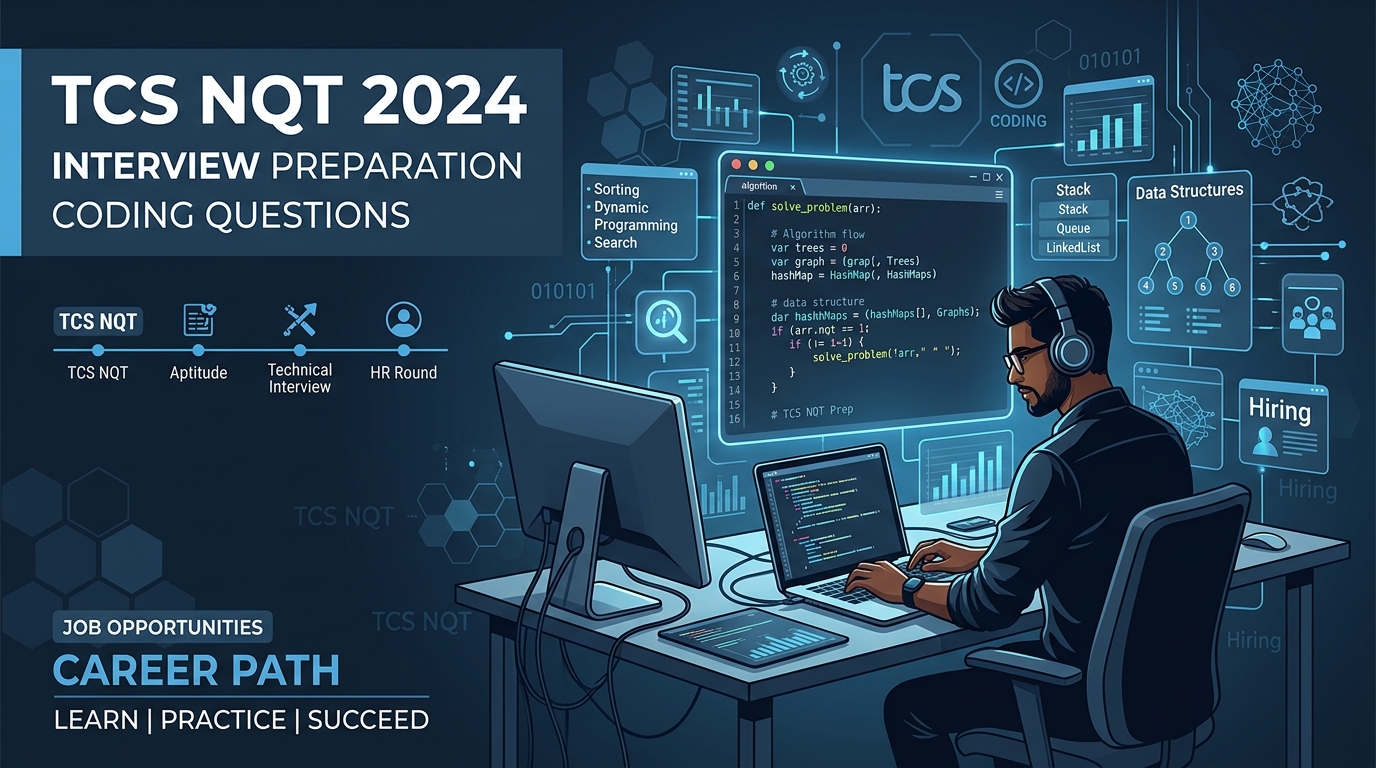
Read next — our latest deep dive TCS NQT ಸಂದರ್ಶನ ಪ್ರಶ್ನೆಗಳು ಮತ್ತು ಉತ್ತರಗಳು (2025 - 2026): ಸಂಪೂರ್ಣ ಸಿದ್ಧತಾ ಮಾರ್ಗದರ್ಶಿ 100+ real technical, coding, managerial and HR questions with worked answers, the full exam pattern, and how the Ninja, Digital and Prime bands are actually decided. The natural next step after this guide.1.2 GCCs are now a first-choice employer, not a fallback
Global Capability Centres — the India engineering arms of global banks, retailers, airlines, healthcare groups and software companies — have moved from back-office support to owning core product engineering. For a fresher this matters for one reason: GCC fresher packages routinely start where a service-company specialist track ends, and GCCs hire on demonstrated skill rather than on percentage cut-offs. They are concentrated in Bengaluru, Hyderabad, Pune, Chennai and Gurugram.
1.3 The skills bar moved, and AI moved it
AI coding assistants have absorbed much of the routine work a first-year engineer used to be hired for. The practical consequence is not that fresher jobs vanished — it is that the definition of an employable fresher changed. Panels now probe whether you understand what the code does, whether you can debug something you did not write, and whether you can state time and space complexity out loud. A candidate who can read and correct AI-generated code is more valuable than one who can only produce it.
If you want the engineering view of that shift rather than the recruitment view, our team has written about how AI is reshaping software development and compared the AI coding assistants worth learning in 2026.
1.4 Non-metro delivery centres are expanding
Tier-2 expansion is real: Indore, Coimbatore, Bhubaneswar, Nagpur, Jaipur, Visakhapatnam, Kochi and Ahmedabad have all gained delivery capacity. For a fresher who is open to those locations, the competition per seat is lower and the cost of living is far more forgiving on a Rs 3.5 LPA package than Bengaluru is.
2. The 12 IT Job Roles Hiring the Most Freshers in 2026
These are the entry-level IT job titles with real fresher volume in India. Each card lists the skills a panel will actually test and an indicative fresher CTC range.
1. Software Developer / Software Engineer Rs 3.5 - 14 LPA
The largest fresher category in Indian IT, covering web, mobile, enterprise and product engineering. Tested on: one language in depth (Java, Python, C++, JavaScript or C#), data structures and algorithms, object-oriented design, SQL, Git, and one framework (Spring Boot, Django, React, Node.js or .NET).
2. Systems Engineer / Associate Engineer (Services Track) Rs 3.2 - 4.5 LPA
The classic mass-intake role at service companies — application support, maintenance, enhancement and migration work on client systems. Tested on: programming fundamentals, SQL, operating system and networking basics, aptitude, and communication. The usual entry point for non-CS branches.
3. Full-Stack Developer Rs 4 - 12 LPA
Front-end plus back-end plus a database, usually on the MERN, MEAN, Java-React or Python-React stack. Tested on: JavaScript and TypeScript, React, REST API design, Node.js or Spring Boot, MongoDB or PostgreSQL, authentication, and at least one deployed project with a public URL.
4. Data Analyst Rs 3.5 - 9 LPA
One of the most accessible high-growth entries for non-CS and commerce-adjacent graduates. Tested on: advanced SQL (joins, window functions, aggregation), Excel, Power BI or Tableau, Python with pandas, and the ability to explain a business metric clearly.
5. Data Engineer Rs 5 - 14 LPA
Building the pipelines analytics runs on. Tested on: SQL, Python, ETL concepts, Apache Spark or Airflow basics, data modelling (star schema, normalisation), and one cloud data platform such as Snowflake, BigQuery, Databricks or Azure Synapse.
6. Cloud Engineer / DevOps Engineer Rs 4.5 - 13 LPA
Rarely a pure fresher title, but reachable from an internship or a strong lab portfolio. Tested on: Linux, networking, one cloud (AWS, Azure or Google Cloud at associate level), Docker, Kubernetes basics, CI/CD with GitHub Actions or Jenkins, and Terraform or Bash scripting.
7. Cybersecurity Analyst / SOC Analyst Rs 4 - 11 LPA
Security Operations Centre hiring is growing steadily across Indian GCCs and managed-security providers. Tested on: networking and the TCP/IP stack, the OWASP Top 10, SIEM concepts, Linux, incident-response basics, and one certification path such as CompTIA Security+.
8. QA / Automation Test Engineer Rs 3.5 - 9 LPA
A genuinely underrated fresher entry with lower competition and a clear growth path into SDET roles. Tested on: manual testing concepts, test-case design, SQL, Selenium or Playwright, API testing with Postman, and basic Java or Python.
9. AI / Machine Learning Engineer Rs 6 - 25 LPA
The highest-paying fresher band, and the most competitive. Tested on: Python, NumPy and pandas, scikit-learn, the mathematics of linear algebra, probability and statistics, PyTorch or TensorFlow, and increasingly retrieval-augmented generation and LLM application patterns.
10. Technical Support Engineer Rs 2.8 - 5.5 LPA
High volume, fast joining dates, and the most common first job for graduates outside CS. Tested on: operating systems, networking fundamentals, ticketing workflows, troubleshooting method, and spoken English. A legitimate route into engineering within two years if you keep studying.
11. UI/UX Designer Rs 3.5 - 9 LPA
Portfolio-driven rather than percentage-driven. Tested on: Figma, design systems, wireframing and prototyping, accessibility, and two or three case studies that show your reasoning, not just the final screen. Our own design standards are summarised in mobile app UX design best practices.
12. Business / Functional Analyst (SAP, Salesforce, ERP) Rs 3.5 - 8 LPA
The route for graduates who are strong on communication and domain logic rather than algorithms. Tested on: requirement gathering, process mapping, SQL, Excel, and one platform's functional module — SAP FICO or MM, Salesforce administration, or an ERP suite.
3. IT Fresher Salary in India 2026: Company-by-Company Table
IT company fresher salary in India is the single most searched question in this whole subject, and the honest answer is that it depends almost entirely on which track you qualify for inside the same company. The service companies all run a tiered structure: a base track for volume intake, a mid specialist track, and an elite programmer track that can pay three to four times the base.
| Employer | Fresher hiring programme | Base track CTC | Specialist / elite track CTC |
|---|---|---|---|
| TCS | TCS NQT (Ninja / Digital / Prime) | Rs 3.36 - 3.6 LPA (Ninja) | Rs 7 - 7.5 LPA (Digital); up to ~Rs 11.5 - 14 LPA (Prime) |
| Infosys | InfyTQ / Off-campus (SE, DSE, Power Programmer) | Rs 3.6 - 4.2 LPA (Systems Engineer) | Rs 6.25 - 9.5 LPA (Digital Specialist); ~Rs 8 - 12 LPA (Power Programmer) |
| Wipro | Elite NTH / WILP / Turbo | Rs 3.5 LPA (Elite) | Rs 6.5 - 9 LPA (Turbo / specialist) |
| HCLTech | HCL TechBee / Graduate hiring | Rs 3.5 - 5 LPA | Rs 6 - 9 LPA (engineering tracks) |
| Accenture | Associate Software Engineer / ADA | Rs 4.5 - 6.5 LPA | Rs 7 - 11 LPA (advanced tracks) |
| Cognizant | GenC / GenC Next / GenC Elevate | Rs 4 - 4.5 LPA (GenC) | Rs 6.5 - 9 LPA (GenC Next / Elevate) |
| Capgemini | Analyst / Senior Analyst exam track | Rs 4 - 4.5 LPA | Rs 6.5 - 7.5 LPA |
| Tech Mahindra | Off-campus graduate hiring | Rs 3.25 - 4 LPA | Rs 5.5 - 7.5 LPA |
| LTIMindtree | Graduate Engineer Trainee | Rs 4 - 4.5 LPA | Rs 6.5 - 8 LPA |
| IBM India | Associate / Graduate hiring | Rs 4.5 - 6 LPA | Rs 8 - 12 LPA |
| GCCs (banking, retail, healthcare, airlines) | Campus & off-campus graduate programmes | Rs 8 - 14 LPA | Rs 15 - 25 LPA and above |
| Product companies & funded startups | SDE-1 / Graduate engineer | Rs 8 - 18 LPA | Rs 20 - 50 LPA+ (top-tier product firms) |
4. Eligibility Criteria: Percentage, CGPA, Backlogs, Gap Years & Branch
More fresher applications are rejected by an automated eligibility filter than by any interview panel. These are the criteria that decide it at most large Indian IT employers.
| Criterion | Typical requirement at large IT service companies | At product companies, startups & GCCs |
|---|---|---|
| Qualification | B.E. / B.Tech, M.E. / M.Tech, MCA, M.Sc, BCA, B.Sc (IT / CS / Maths / Stats) | Any degree; some accept self-taught candidates with a portfolio |
| Aggregate marks | Minimum 60% or 6.0 CGPA in 10th, 12th and degree | Often no cut-off; coding test score decides |
| Active backlogs | None permitted at the time of joining | Usually flexible if the degree completes |
| Education gap | Generally not more than 2 years, and must be explainable | Rarely a formal barrier |
| Batch / year of passing | Specified batch only (for example 2026 or 2027 batch) | Open; "0 - 1 year experience" postings also accept freshers |
| Age limit | Commonly up to 28 years for fresher programmes | No limit in practice |
| Relocation & shifts | Must agree to any India location and rotational shifts | Role-specific |
4.1 If you do not meet the 60% criterion
You are not out of the IT market — you are out of the volume-hiring segment of it. Three routes stay fully open: product companies and startups that screen on a coding test, GCCs that hire on skill, and the staffing and IT-consultancy route where a six-month contract converts to a full-time offer on performance. A strong GitHub profile is worth more in all three than a percentage is.
4.2 If you have a gap year or a career break
Name it plainly and attach something productive to it: a certification, freelance work, a family-business responsibility, a health reason, or exam preparation. Panels penalise evasiveness about a gap far more heavily than the gap itself.
5. Off-Campus Drive Calendar 2026 - 2027 (Month by Month)
Off-campus drives are open to any eligible graduate rather than only to students of a partner college, and they are where most freshers outside Tier-1 campuses actually get hired. The windows below reflect the pattern Indian IT employers have followed in recent cycles — treat them as a watch-list, and confirm each one on the company's own portal.
| Period | Typically open | What to do in that window |
|---|---|---|
| Oct - Dec | Campus season at partner colleges; TCS NQT cycle; GCC graduate programmes; winter internship intake | Register on every official portal now and sit the NQT as early as you are eligible — the scorecard stays valid for two years |
| Jan - Feb | Accenture, Cognizant GenC, Capgemini exam cycles; startup SDE hiring | Finish one portfolio project and get your resume ATS-clean before the exams open |
| Mar - Apr | Infosys and Wipro volume drives; TCS NQT testing window; financial-year-start demand | The densest window of the year — apply to everything you are eligible for, same week it opens |
| May - Jun | Final-year results clear; mass off-campus for the just-graduated batch; walk-in interviews | Get your provisional degree certificate and all mark sheets scanned and ready |
| Jul - Aug | Second-half intake; QA, support and analyst roles; staffing-partner contract-to-hire | Widen to Tier-2 cities and to QA, support and analyst titles — competition per seat is much lower |
| Sep - Oct | Next cycle's campus and pre-placement offers; mid-year lateral-adjacent fresher roles | Pre-final-year students: convert an internship into a PPO instead of job-hunting next year |
6. Where to Apply: Official Career Portals & Job Sites
Apply on the employer's own portal wherever one exists. Aggregator listings are useful for discovery and unreliable for deadlines — and the application that reaches a recruiter's shortlist is almost always the one submitted through the official system with a reference ID attached.
🌐 Official fresher hiring portals in India
Register once on each, keep every reference ID and registered email in one note, and never pay a third party for a "guaranteed slot" — none of these portals charge a fresher any fee.
6.1 Job portals and aggregators worth your time
- Naukri — the largest pool of Indian fresher postings. Use the "0 - 1 year" experience filter plus the walk-in tag, and set a daily email alert per role title.
- LinkedIn — best for GCC and product roles. Set your headline to the job title you want, turn on "Open to work" quietly, and apply within 24 hours of a posting going live.
- Internshala — internships and fresher roles, including genuinely remote ones.
- National Career Service (ncs.gov.in) — the Government of India portal, which also carries PSU and state IT postings.
- Company career pages directly — the highest-signal channel, and the only one where the deadline is authoritative.
Hiring at Codexal
We build AI, SaaS and data products for clients across the Middle East, Asia and India, and we hire software engineers, AI developers, UI/UX designers, QA engineers and DevOps specialists — including remote and internship positions open to candidates in India.
→ See the current openings on the Codexal Careers page
→ QA & software testing internship · → Automation / n8n internship · → Send your CV through the contact page
7. The Skills Stack That Actually Gets Shortlisted
Breadth loses to depth at fresher level. One language you genuinely know, SQL, and one deployed project beat a resume listing fourteen technologies you have each touched for a week.
7.1 The non-negotiable base, whatever role you target
- One programming language, properly: Java, Python, C++, JavaScript or C#. "Properly" means you can write it on paper without autocomplete.
- Data structures and algorithms: arrays, strings, hash maps, linked lists, stacks, queues, trees, sorting and searching, plus two pointers, sliding window and recursion. Roughly 150 - 250 well-understood problems is the practical target, not 1,000 skimmed ones.
- SQL: joins, GROUP BY, subqueries, window functions. Asked in almost every Indian IT interview, including for non-development roles.
- Computer science fundamentals: OOP, operating systems (process vs thread, deadlock, paging), DBMS (normalisation, indexes, ACID, transactions) and computer networks (TCP vs UDP, the HTTP request lifecycle, DNS).
- Git and GitHub: branch, commit, merge, pull request — and a profile with real commits in it.
- English communication: the most under-practised and most decisive skill in the entire pipeline.
7.2 Role-wise add-ons
| Target role | Add these on top of the base | Portfolio proof that works |
|---|---|---|
| Full-stack developer | React, TypeScript, Node.js or Spring Boot, REST APIs, PostgreSQL or MongoDB, JWT auth | A deployed app with login, a database and a public URL |
| Data analyst | Advanced SQL, Excel, Power BI or Tableau, Python with pandas, basic statistics | A dashboard built on a real public dataset, with the business question stated |
| Data engineer | ETL design, Apache Spark or Airflow, data modelling, one cloud warehouse | A scheduled pipeline that ingests, cleans and loads data end to end |
| Cloud / DevOps engineer | Linux, AWS or Azure associate level, Docker, Kubernetes basics, CI/CD, Terraform | A containerised app with a working CI/CD pipeline and infrastructure as code |
| Cybersecurity analyst | Networking, OWASP Top 10, SIEM concepts, Linux hardening, Security+ syllabus | A documented vulnerability assessment of a deliberately insecure lab app |
| QA / automation engineer | Test-case design, Selenium or Playwright, Postman, TestNG or PyTest, basic CI | An automated regression suite on a public demo site, with a test report |
| AI / ML engineer | Python, scikit-learn, PyTorch or TensorFlow, linear algebra and statistics, RAG and LLM APIs | A model or LLM application deployed behind an API, with evaluation numbers |
8. How the Hiring Process Works: Assessment, Technical, Managerial, HR
Almost every large Indian IT employer runs the same four-stage pipeline. Knowing what each stage is actually scoring is worth more than extra practice on the wrong stage.
Stage 1 — Online assessment
Aptitude (numerical, verbal, logical reasoning), a technical MCQ section, and one to three coding problems, under strict sectional timers you cannot navigate back across. This stage is a filter, and in the tiered companies it is also the band allocator: how deep you get into the advanced coding section decides whether you interview for the base track or the elite one.
Stage 2 — Technical interview
25 to 60 minutes on your resume's own claims plus core CS. Expect OOP with examples, SQL queries written live, one or two coding problems with complexity stated aloud, operating system and networking fundamentals, and a deep interrogation of your final-year project. The fastest way to fail is to list something you cannot defend.
Stage 3 — Managerial round
Situational and behavioural, usually answered best with the STAR method (Situation, Task, Action, Result): conflict in a team project, a missed deadline, learning an unfamiliar technology under time pressure, taking ownership when something broke.
Stage 4 — HR round
Fit, willingness to relocate anywhere in India, openness to rotational shifts, salary expectation, backlog status and notice period. Short, and routinely underestimated — a hesitant answer on relocation is a common late-stage rejection.
Go deeper on every stage above TCS NQT Interview Questions and Answers (2025 - 2026) — 100+ Real Questions with Answers The complete exam pattern and marking scheme, OOP, DBMS, SQL, OS and networking questions with model answers, real coding problems with multi-language solutions, managerial STAR cases, HR scripts, and how to convert a base-track interview into a Digital or Prime offer.9. Resume & ATS: Why Good Candidates Get Filtered Out
Large Indian IT employers screen fresher resumes through an Applicant Tracking System before a human sees them. Most rejections at this step are formatting, not merit.
9.1 The rules that decide it
- One page, single column, no tables or text boxes. Multi-column and graphic layouts get parsed out of order or not at all.
- No photo, no graphic skill bars, no icons for contact details. They carry no machine-readable information.
- Mirror the posting's language. If the job says "Java Developer" and your headline says "Software Aspirant", you lose the keyword match. Use the exact title.
- A real Skills section listing the technologies named in the job description — spelled the way the posting spells them.
- Projects described by result, not by activity: "Built a Spring Boot and React inventory app; cut manual stock reconciliation from 2 hours to 10 minutes for a 40-store dataset" beats "Worked on an inventory project".
- Percentage or CGPA stated explicitly for 10th, 12th and degree. Eligibility bots look for these numbers and reject on absence.
- GitHub and LinkedIn URLs in plain text, not hidden behind a hyperlinked word.
- PDF unless the portal asks for Word, and name the file
Firstname-Lastname-Role.pdf.
- "Declaration: I hereby declare that the above information is true" — it adds nothing and consumes a line.
- Father's name, marital status, full home address and date of birth. Your city and state are enough.
- Objective statements that say nothing ("seeking a challenging position in a reputed organisation").
- Any skill you could not survive five follow-up questions on.
10. Work From Home & Remote IT Jobs for Freshers in India
Work from home jobs for freshers is one of the highest-volume searches in India and also the single most scam-infested corner of the market. Both facts need stating together.
10.1 Where genuine remote fresher roles actually exist
- Technical support and customer success at SaaS companies serving US and EU time zones.
- QA and manual testing for distributed product teams.
- Data annotation, data entry and analytics support for AI and research teams — and a legitimate entry point into data work.
- Junior web development at agencies and small studios, usually starting as a paid internship.
- Technical content writing and documentation for developer-tools companies.
10.2 What to expect realistically
Most large Indian IT employers hire freshers on a hybrid model with mandatory base-location reporting through the initial training programme, because onboarding, mentoring and client compliance all assume a physical office for the first months. Fully remote fresher offers are more common at startups, agencies and global companies hiring individual contributors — and they usually pay less than the equivalent on-site role, not more. An offer promising a high remote salary with no interview is the classic shape of a scam; see section 14.
11. Government & PSU IT Jobs in India
Government IT jobs trade a lower starting package for job security, structured pay revisions and defined working hours. They run on exam calendars, not on rolling applications, so they belong in your plan months ahead.
| Employer / exam | Typical IT roles | Route in |
|---|---|---|
| ISRO | Scientist / Engineer SC (Computer Science) | ISRO centralised recruitment exam plus interview |
| DRDO | Scientist B (CS / IT) | GATE score plus DRDO interview |
| BEL, BHEL, NTPC, ONGC and other PSUs | Engineer Trainee (IT / CS) | Mostly GATE-based, some with their own written test |
| NIC / NIELIT | Scientific / Technical Assistant, Scientist B | Own written examination |
| IBPS SO, SBI, RBI | IT Officer Scale I, Specialist Officer (IT) | Banking specialist-officer exams |
| Railways (RRB), SSC | Junior Engineer (IT), Computer Operator, Programmer | RRB and SSC notifications |
| State IT departments & e-governance units | Programmer, Database Administrator, Network Engineer | State public service commission notifications |
If a government IT career is the goal, GATE in Computer Science is the highest-leverage single exam — it feeds PSU recruitment, DRDO, several research labs and M.Tech admissions from one score. Watch ncs.gov.in and the individual organisation websites for notifications rather than aggregator sites.
12. Internships, PPOs and the Apprenticeship Route
The least competitive way into an Indian IT job is to not compete for it in the open market at all. Three routes do that.
- Internship to pre-placement offer (PPO). A good six-month internship in your pre-final year converts to a full-time offer far more often than a cold application does, and it usually converts at a higher band than the volume track pays.
- Government apprenticeship schemes. NAPS and NATS apprenticeships at IT and electronics employers pay a stipend, carry a recognised certificate, and are a genuine conversion path for diploma and B.Sc graduates.
- Contract-to-hire through staffing partners. A six to twelve month contract placed at a large client, converting to full-time on performance. Lower prestige, materially higher conversion rate, and real production experience on your resume either way.
We run paid internships ourselves in QA and software testing and in workflow automation with n8n, and every opening is listed on the Codexal careers page.
13. City-Wise IT Job Hubs and the Cost-of-Living Reality
Where you are willing to work changes both your odds and what your package is actually worth.
| City | Strongest in | Fresher reality check |
|---|---|---|
| Bengaluru | Product companies, startups, GCCs, AI and ML | Highest packages and highest competition; rent and commute consume a large share of a base-track salary |
| Hyderabad | GCCs, product engineering, services, cloud | Strong salary-to-cost ratio; the best overall balance for many freshers |
| Pune | Services, automotive software, fintech, GCCs | Large fresher intake with a more manageable cost of living than Bengaluru |
| Chennai | Services, BFSI delivery, SaaS, embedded | Very high services volume; a reliable first-job market |
| Noida, Gurugram & Delhi NCR | GCCs, consulting, product, ed-tech | Wide range of employers; verify smaller firms carefully before accepting |
| Mumbai | Fintech, banking technology, media tech | Strong domain exposure; the highest living costs in the country |
| Kolkata, Kochi, Ahmedabad, Indore, Coimbatore, Bhubaneswar, Jaipur | Delivery centres, services, growing GCC presence | Lower competition per seat and a far better salary-to-cost ratio; smaller ceiling later |
14. How to Spot a Fake Job Offer or Placement Scam
Fresher job scams in India follow a small number of repeating patterns. One rule removes the majority of the risk: a legitimate employer never asks a candidate for money.
- A registration, training, security-deposit, laptop or document-verification fee of any size.
- An offer letter arriving before any interview took place.
- A recruiter writing from a gmail, outlook or yahoo address instead of the company's own domain.
- An entire "interview" conducted over WhatsApp or Telegram text, with no call and no video.
- Pressure to accept or pay within hours, or a "limited seats" countdown.
- A quoted package far above the published band for that role and experience level.
- A request for your Aadhaar, PAN, bank details or an OTP before a verified offer exists.
- A "job guarantee" sold alongside a paid course.
14.1 How to verify an offer in five minutes
- Search the exact job title on the company's own careers domain. If the opening is not there, it probably does not exist.
- Check the recruiter's email domain character by character — scam domains differ by one letter or add a hyphen.
- Look the recruiter up on LinkedIn and check that their current employer matches.
- Call the company's published switchboard number from its official website — never a number supplied in the offer email.
- Pay nothing, and share no Aadhaar, PAN, bank or OTP detail, until you have a verified offer letter from a verified domain.
15. Understanding Your Offer: CTC vs In-Hand, Bonds & Service Agreements
Read the offer letter as carefully as you prepared for the interview. Four things decide what the number means.
- CTC vs in-hand. CTC includes basic pay, House Rent Allowance, the employer's Provident Fund contribution, gratuity, insurance premiums and a performance bonus. Monthly in-hand pay at fresher level often lands around 70 - 80% of CTC divided by twelve, after Provident Fund, professional tax and income tax.
- The variable component. Ask what percentage of CTC is a performance or retention bonus and on what condition it pays out. A "Rs 4.5 LPA" offer with Rs 60,000 of conditional variable pay is a Rs 3.9 LPA offer until it is not.
- Service agreement or bond. Common at large service companies: a minimum tenure, typically 12 to 24 months, with a stated recovery amount if you leave earlier. It is legal in India when it is tied to documented training cost — read the amount, the duration and the exit clause before you sign.
- Joining date and onboarding risk. At large service companies the gap between offer and joining can stretch for months, because batch allocation follows project demand. Keep applying until you have a confirmed date of joining in writing.
16. Your 90-Day IT Job Search Plan
If you are starting from a blank page, this is the sequence that produces interviews fastest.
Days 1 - 30 · Build the base
Days 31 - 60 · Prove it
- Ship one deployed project with a public URL and a real README.
- Another 80 - 100 DSA problems: trees, recursion, two pointers, sliding window.
- Revise OOP, DBMS, OS and networking out loud, not by reading.
- Sit every assessment you are eligible for — the TCS NQT guide covers the pattern in full.
- Apply to 10 - 15 roles a week through official portals.
Days 61 - 90 · Convert
- Run 8 - 10 mock interviews, recorded, with a peer.
- Write and rehearse STAR answers for six situational questions.
- Prepare a crisp 3-minute walkthrough of your project.
- Widen to QA, support, analyst and Tier-2 city roles.
- Follow up on every application older than 10 days.
17. Frequently Asked Questions (FAQ)
The Short Version
The Indian IT fresher market in 2026 rewards depth over breadth, assessments over applications, and proof over claims. Pick one role and one language, get genuinely good at data structures and SQL, ship one project a stranger can open, fix your resume so a machine can read it, register on the official portals today, and sit every assessment you qualify for — because in the tiered companies that single test decides whether you are offered Rs 3.5 LPA or Rs 11 LPA for the same job title.
Keep Going
Your next step is the interview itself — and then the engineering. Both are covered in depth on the Codexal blog.
TCS NQT Interview Questions & Answers → Open Roles at Codexal →