How is AI Reshaping Software Development? The 2026 Perspective
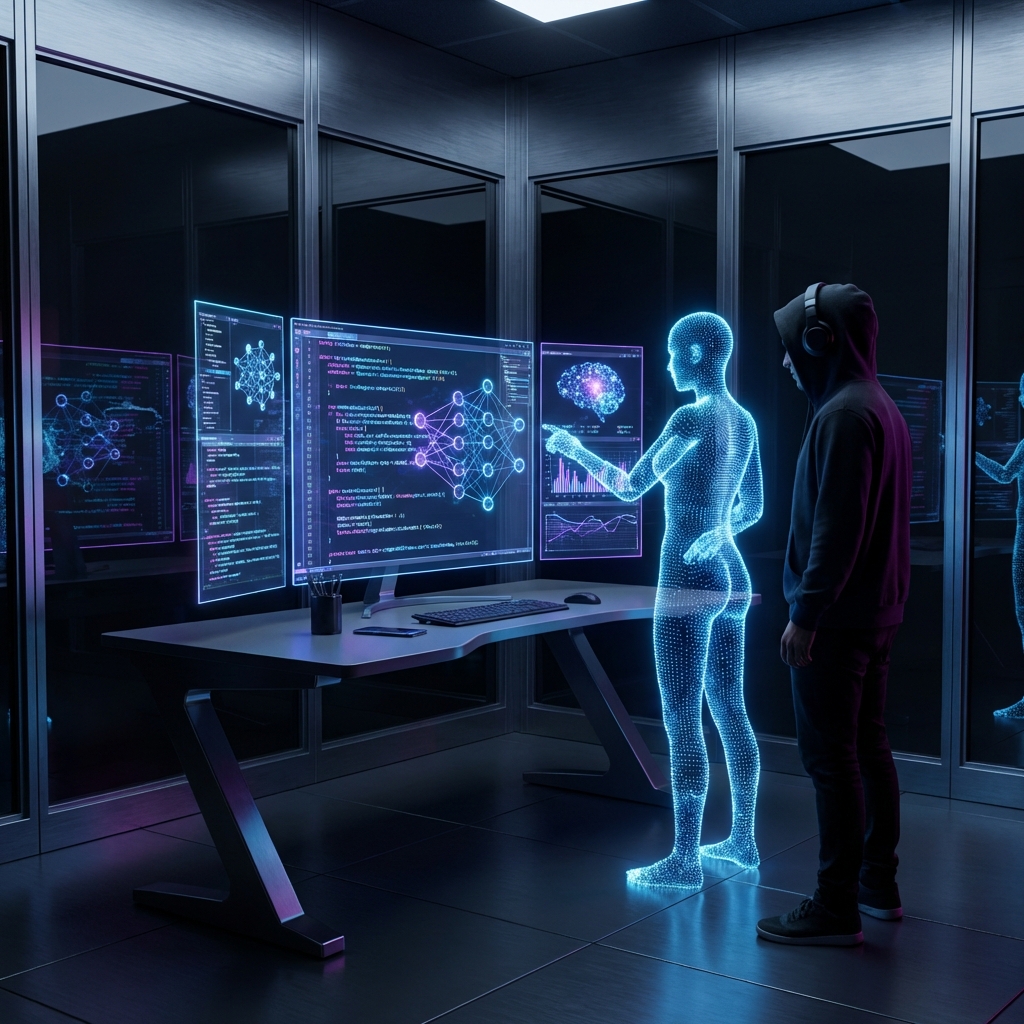
The dawn of 2026 has brought with it a fundamental shift in how we conceive, build, and maintain digital products. For decades, the primary tool of the programmer was the text editor—a passive interface for manual logic. Today, that editor has become an active collaborator. Artificial Intelligence (AI) is no longer just a "pair programmer"; it is an architectural cornerstone that is redefining the very identity of a "software engineer."
1. Redefining Coding Efficiency: From Syntax to Intent
In the past, developers spent a significant portion of their day grappling with syntax, boilerplate code, and documentation lookups. With the rise of Large Language Models (LLMs) specifically trained on codebases, the Focus has shifted from how to write a instruction to what that instruction should achieve. This is the era of Intent-Based Development.
Modern AI agents can now generate entire feature scaffolds based on a single requirement document. They understand project-specific styles, naming conventions, and architectural patterns. For example, when building complex Fintech Applications, AI can automatically suggest the necessary encryption layers and regulatory compliance hooks, saving hundreds of hours of manual research.
2. The End of Manual Bug Hunting: AI in Testing
Testing has traditionally been the "bottleneck" of the software lifecycle. Creating comprehensive unit tests, integration tests, and end-to-end simulations is tedious and often incomplete. AI is flipping the script by enabling Self-Healing Test Suites.
When a UI element changes—perhaps a button ID is updated or a layout is shifted during a Mobile UX Redesign—traditional tests would fail. AI-powered testing tools can now recognize the intent of the test, adjust to the UI change, and continue the validation. Furthermore, Generative AI can create "edge-case" data that human testers might never imagine, catching vulnerabilities before they reach the production environment.
3. AI as a Technical Architect
System design is perhaps the most difficult skill for a human to master. It requires balancing scalability, security, cost, and maintainability. AI is now being used to run Architectural Simulations. By feeding the AI current traffic patterns and growth projections, architects can receive multiple "what-if" scenarios for their Cloud Transformation strategies.
Should we use a microservices approach or a modular monolith? AI can analyze the specific performance characteristics of your code and predict where the bottlenecks will occur two years from now. This predictive capability turns "best-guess" architecture into a data-driven science.
4. Shifting Left Beyond Security: AIOps
The integration of AI into DevOps—often called AIOps—has revolutionized the "Run" phase of software. By continuously monitoring logs, metrics, and traces, AI can detect anomalies that indicate an impending failure long before a human operator notices. This proactive maintenance is the essence of our DevOps for Fast, Safe Releases philosophy.
In 2026, we are seeing systems that not only detect an issue but also propose and automatically apply the fix (in a staging environment) for developer approval. This "Self-Correcting Infrastructure" is the holy grail of system reliability.
5. Cybersecurity in the Age of AI Coders
While AI makes coding faster, it also makes it easier for bad actors to generate sophisticated exploits. Consequently, the "AI Defense" must be stronger than the "AI Attack." Automated security scanning is now real-time. As a developer types, an AI agent is scanning for SQL injection, hardcoded secrets, and outdated dependencies.
This "Real-time Hardening" ensures that Cybersecurity Best Practices are followed by every developer, regardless of their seniority level. It democratizes high-level security knowledge across the entire team.
6. The Evolving Role of the Human Developer
With AI handling the "grunt work," many ask: Will humans still be needed? The answer is a resounding yes, but the role has changed. The developer of 2026 is more of a Solution Architect and Orchestrator.
The focus has moved toward:
- Problem Framing: Deeply understanding business needs and translating them into technical constraints.
- Ethical Oversight: Ensuring AI-generated logic doesn't introduce bias or unethical outcomes.
- Strategic Integration: Ensuring that individual software components work harmoniously within a larger Digital Transformation ecosystem.
- Creative Innovation: Solving problems that have no historical precedent, where AI has no training data to draw from.
Conclusion: Embracing the Augmented Future
AI is not replacing the software developer; it is augmenting their potential. We are moving from a era of "Craftsmanship" (where every line is hand-carved) to an era of "Industrialization" (where high-quality components are assembled intelligently). This allows us to build bigger, safer, and more innovative solutions than ever before.
At Codexal, we are at the forefront of this revolution. We integrate AI into every stage of our delivery pipeline to ensure our clients receive the most advanced digital solutions on the market.
Ready to see how AI-driven development can transform your business? Explore our AI and Software Services or contact us for a deep-dive consultation.
Future Trends: Beyond 2026
Looking even further ahead, we anticipate the rise of Natural Language Programming as a secondary interface for non-technical stakeholders. Imagine a CEO describing a new dashboard feature in plain English and seeing a functional prototype generated in minutes. The wall between "The Business" and "The Tech" is finally crumbling.
Furthermore, the concept of "Software Maintenance" may disappear as we know it. Systems will be able to refactor themselves to take advantage of new library versions or cloud features without human intervention, maintaining a state of perpetual modernization.