CODEXAL RESEARCH · TECHNICAL VISION PAPER · CXL-TR-2026-01
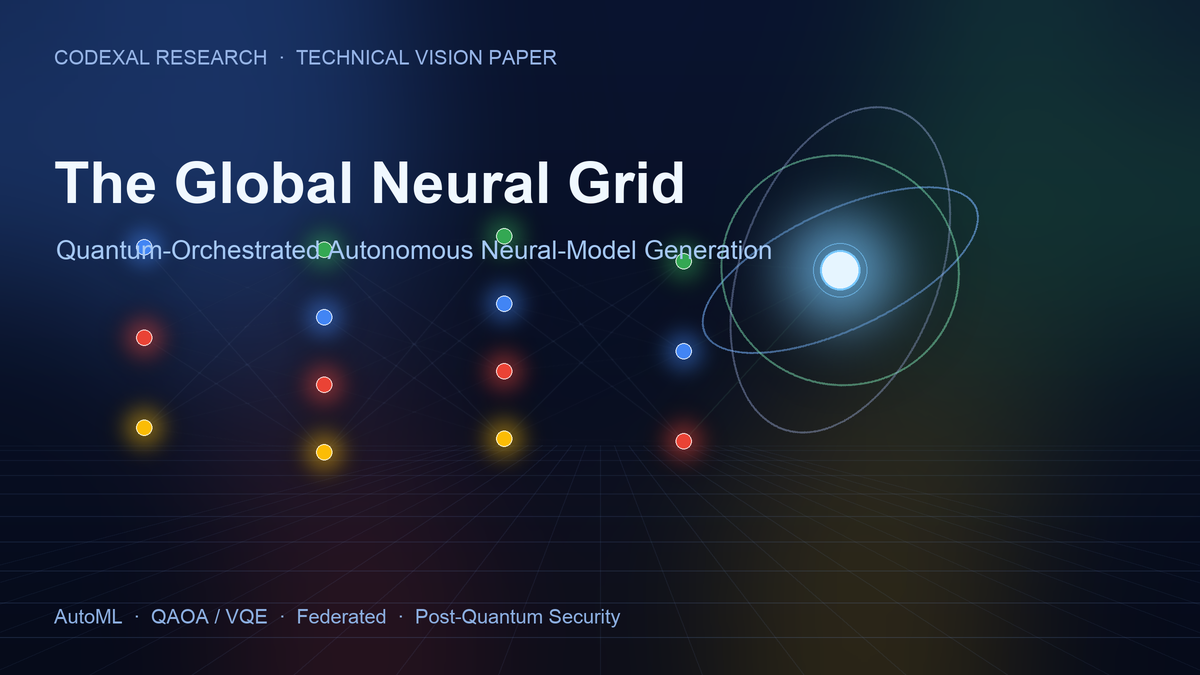
The Global Neural Grid: A Quantum-Orchestrated Architecture for Autonomous Neural-Model Generation
A Conceptual Framework Unifying Automated Machine-Learning, Variational Quantum Optimization, and Quantum-Secured Multi-Agent Communication
Codexal — Global Neural Grid Division | gng.codexal.co
Abstract
The cost, latency, and human expertise required to design, train, and continuously refine modern neural models have become the dominant bottleneck of the deep-learning era. We present the Global Neural Grid (GNG), a conceptual reference architecture in which the design of new neural models is reformulated as a combinatorial optimization problem and delegated to a hybrid quantum–classical control plane, while deployed models exchange parameters and meta-knowledge over a geographically distributed, quantum-secured fabric. GNG composes four well-established research threads into a single closed loop: (i) automated architecture discovery in the lineage of Neural Architecture Search and AutoML‑Zero [1,2,3]; (ii) variational quantum optimization (QAOA / VQE) as the engine that explores the discrete architecture and hyperparameter space [8,9]; (iii) federated, multi-agent coordination among deployed models [5,6]; and (iv) a defense-in-depth security stack combining quantum key distribution with NIST-standardized post-quantum cryptography [11,12]. We formalize the generate–evaluate–select loop, derive the optimization objective, and position each component against the peer-reviewed literature. We are explicit about what is demonstrated by today's hardware versus what remains a research target: the present paper is a vision and systems-design contribution, not a report of completed benchmarks. We close with a candid analysis of the open challenges—NISQ noise, barren plateaus, evaluation cost, and trust—that any honest reading of the field must confront.
Keywords: AutoML, Neural Architecture Search, Variational Quantum Algorithms, QAOA, Quantum Machine Learning, Federated Learning, Quantum Key Distribution, Post-Quantum Cryptography, Autonomous Systems.
1. Introduction
Over the last decade the design of high-performing neural networks has shifted from a craft practiced by experts to a search problem solved by machines. Neural Architecture Search (NAS) demonstrated that a controller trained by reinforcement learning could discover convolutional and recurrent cells competitive with the best hand-designed architectures [1]. AutoML‑Zero then pushed the idea further: even the learning algorithm itself—including back-propagation—can be rediscovered from elementary mathematical operations under evolutionary search [2].
Two costs, however, still dominate. First, the search itself is expensive: the seminal NAS result consumed on the order of 800 GPUs running for two weeks to reach competitive accuracy [1]. Second, models do not exist in isolation—once deployed they must be kept current, coordinated, and protected as they exchange information. GNG's thesis is that both costs can be attacked by re-architecting the pipeline around two complementary substrates: a quantum optimization plane that searches the discrete design space, and a quantum-secured communication plane that lets deployed models share what they learn. GNG is not a single model; it is a control architecture whose output is models.
2. Background & Related Work
2.1 Automated model design
NAS casts architecture design as a sequential decision process: a controller emits a string of tokens describing a candidate network, the network is trained, and its validation accuracy is fed back as a reward [1]. Surveys catalogue thousands of follow-on papers and consolidate best practice for search spaces and weight-sharing [3]. AutoML‑Zero shows that even the optimizer and the loss can be evolved from scratch [2], motivating GNG's model-to-model design.
2.2 Distributed & multi-agent learning
Federated Averaging showed that deep networks can be trained across decentralized data with one to two orders of magnitude fewer communication rounds than naïve synchronization [5]—the foundation for sharing model updates without sharing raw data. Separately, deep multi-agent reinforcement learning shows that agents can invent communication protocols to coordinate under partial observability [6], motivating GNG's model-to-model communication.
2.3 Quantum optimization & learning
Variational Quantum Algorithms (VQAs) use a classical optimizer to tune a parameterized quantum circuit and are the leading candidates for practical advantage on noisy, intermediate-scale quantum (NISQ) hardware [8]. The Quantum Approximate Optimization Algorithm (QAOA) and the Variational Quantum Eigensolver (VQE) map combinatorial and chemistry problems onto shallow, trainable circuits [7,9]. This idea—encode a hard problem in the spectrum of a cost Hamiltonian, then use a classical loop to drive qubits toward its ground state—is GNG's combinatorial engine.
2.4 Quantum-grade security
A 46-node quantum metropolitan-area network has been operated in the field, distributing keys with resilience to varied topologies and node failures [11], demonstrating that quantum key distribution (QKD) is deployable at city scale. In parallel, NIST finalized the first post-quantum cryptographic standards—FIPS 203 (ML-KEM), 204 (ML-DSA) and 205 (SLH-DSA)—providing software-only, quantum-resistant key establishment and signatures [12]. GNG combines both.
3. System Overview
GNG is organized as three planes (Figure 1). The orchestration plane is where the "what model should exist next?" question is answered and a set of geographically distributed optimizers (classical CPU/GPU clusters fronting a quantum processing unit) propose candidate designs. The model/data plane is the population of trained, deployed models that serve real traffic and generate fresh telemetry. The communication plane is the geographically distributed fabric over which model parameters, gradients, and meta-knowledge move—every byte of it confidential, authenticated, and auditable. The three planes form a single feed-back loop: telemetry from deployed models (model/data plane) sharpens the next search round (orchestration plane); winning designs are deployed and replicated; replication and federation close the loop over the communication plane.
4. Quantum-Orchestrated Model Generation
4.1 Search space as a discrete optimization problem
Let a candidate model be described by a vector of n binary design decisions x ∈ {0,1}n—presence of a residual connection, choice of attention head count, layer width, activation family, and so on. Validity and resource budgets are encoded as constraints. Following the standard reduction used throughout combinatorial optimization, we encode the design objective as a Quadratic Unconstrained Binary Optimization (QUBO) form,
where the linear terms ai capture the marginal value or cost of each decision and the quadratic terms bij capture interactions (e.g. depth and width jointly driving memory). Equation (1) maps directly onto an Ising Hamiltonian by the substitution xi = (1 − zi)/2 with zi ∈ {−1, +1}:
The optimal architecture corresponds to the ground state of the cost Hamiltonian HC [9].
4.2 Variational search via QAOA
QAOA prepares a parameterized state by alternating evolutions under the cost Hamiltonian HC and a mixing Hamiltonian HB = Σi Xi:
A classical optimizer minimizes the measured energy E(γ,β) = ⟨ψ| HC |ψ⟩, and the bitstring sampled most frequently at the optimum is decoded back into a concrete architecture [8,9]. The same variational template, with a chemistry-style ansatz, yields VQE when the design problem is posed as an eigenvalue rather than a combinatorial task [9]. Crucially, this is a hybrid loop: the quantum processor evaluates a hard-to-sample landscape, while a robust classical routine performs the outer optimization.
4.3 Why a quantum substrate
The architecture-and-hyperparameter space is exponential in n and rich in the kind of rugged, highly-coupled structure that QUBO/Ising formulations target. Variational quantum optimization offers a physically distinct sampler over this landscape, and the existence of sampling regimes beyond classical reach on real hardware [10] is the empirical basis for expecting eventual advantage. We emphasize—and return to in §8—that provable end-to-end speed-ups for this specific use case are not yet established; GNG is engineered so that the quantum plane is an accelerator within a loop that remains correct, if slower, on purely classical optimizers.
5. The Autonomous Lifecycle
GNG operates as a continuously running closed loop with minimal human intervention, in the spirit of automated discovery established by NAS and AutoML‑Zero [1,2]. One full cycle (Figure 3) proceeds as:
- Generate. The orchestrator solves Eq. (1) to propose a population of candidate architectures.
- Train. Candidates are trained on the distributed nodes; partial-training and weight-sharing reduce the per-candidate cost.
- Evaluate. A multi-objective score combines validation quality, latency, energy, and robustness.
- Select. Survivors update the cost Hamiltonian's coefficients, biasing the next search toward the region of design space that produced them—an evolutionary pressure analogous to regularized evolution [2].
- Federate. Knowledge from surviving models is shared across nodes as model updates, not raw data, over the secured channel of §6 [5].
- Deploy & observe. Promoted models serve real traffic; their live telemetry becomes the objective for the next cycle, closing the loop.
Human operators set policy—objectives, budgets, safety constraints, and approval gates—but are not in the inner loop of each iteration. This is the precise and defensible sense in which GNG operates "without human intervention": the search–train–select cycle is autonomous within a human-defined envelope, not unbounded self-modification.
6. Quantum-Secured Model Communication
Autonomous models that exchange parameters are an attractive attack surface: GNG therefore treats security as a first-class plane rather than an add-on. Its defense-in-depth stack (Figure 4) layers two independent guarantees so that a break in either alone is insufficient:
- Physical layer — QKD. Symmetric keys are distributed photonically; their secrecy rests on physical law rather than computational hardness, and city-scale, multi-node operation has been demonstrated in the field [11].
- Algorithmic layer — PQC. Where fiber/QKD reach is unavailable, key establishment and signatures use NIST-standardized, quantum-resistant schemes—ML-KEM (FIPS 203), ML-DSA (FIPS 204) and SLH-DSA (FIPS 205) [12].
- Session layer. Every model-to-model (A2A) session is mutually authenticated and bound to an attested model identity.
- Audit layer. All exchanges are written to a tamper-evident log, giving operators the accountability that autonomy demands.
Hybridizing information-theoretic (QKD) and computational (PQC) security is deliberate: it removes any single point of cryptographic failure during the long transition to a fault-tolerant-quantum world.
7. Positioning Against the State of the Art
Table 1 situates each GNG component against an established, peer-reviewed result—separating what the literature already demonstrates from the integration GNG proposes.
| GNG component | Established basis | Ref. |
|---|---|---|
| Automated architecture proposal | RL controller designs competitive CNN/RNN cells | [1] |
| Algorithm-level discovery | Evolution finds learning algorithms from scratch | [2] |
| Model backbone | Attention-only Transformer | [4] |
| Combinatorial search engine | QAOA / VQE over QUBO–Ising problems | [8,9] |
| Distinct compute regime | Programmable QPU beats classical sampling | [10] |
| Decentralized knowledge transfer | Federated Averaging | [5] |
| Model-to-model protocols | Emergent multi-agent communication | [6] |
| Physical-layer key secrecy | 46-node field QKD network | [11] |
| Algorithmic quantum-resistance | NIST FIPS 203/204/205 | [12] |
8. Limitations & Open Challenges
A vision is only credible if its weak points are stated plainly. We identify five.
- (i) NISQ-era hardware. Today's quantum processors are noisy and shallow; VQAs must contend with decoherence and limited qubit counts, and a practical advantage for our specific QUBO instances is a research target, not a settled result [8,9].
- (ii) Barren plateaus. Variational landscapes can exhibit exponentially vanishing gradients as systems scale, complicating the outer optimization of Eq. (3); mitigation (structured ansätze, local cost functions) is an active area [8].
- (iii) Evaluation cost. Even with quantum-accelerated search, training each candidate model dominates wall-clock time; GNG relies on weight-sharing and low-fidelity proxies whose biases are themselves a known NAS pitfall [3].
- (iv) Autonomy and trust. A closed loop that promotes its own models requires rigorous guardrails, attestation, and audit (§6) to remain governable; we frame "no human in the inner loop" as an operation within a human-defined policy envelope, never as unbounded self-modification.
- (v) Integration risk. Each cited result is established in isolation; their composition into a single end-to-end system is precisely the unproven, ambitious claim that must be validated incrementally.
9. Conclusion & Roadmap
We have presented the Global Neural Grid: a control architecture that treats model creation as a quantum-assisted optimization problem, runs that creation as an autonomous closed loop, and protects the resulting model ecosystem with hybrid quantum-grade security. Every load-bearing claim is anchored to peer-reviewed work, and every gap between today's hardware and tomorrow's ambition is stated rather than hidden. Our roadmap is staged: (R1) classical-only validation of the full loop; (R2) substitution of the search stage with QAOA/VQE on current QPUs for small n; (R3) federated multi-node operation with the QKD + PQC stack; and (R4) scale-up as fault-tolerant quantum resources mature. GNG's value does not hinge on any single future breakthrough—it is engineered to remain correct on classical substrates while compounding whatever quantum advantage the field delivers.
Full Whitepaper (PDF)
References
- B. Zoph and Q. V. Le, "Neural Architecture Search with Reinforcement Learning," ICLR, 2017. arXiv:1611.01578.
- E. Real, C. Liang, D. R. So, and Q. V. Le, "AutoML-Zero: Evolving Machine Learning Algorithms from Scratch," ICML (PMLR vol. 119), 2020. arXiv:2003.03384.
- C. White, M. Safari, R. Sukthanker, B. Ru, T. Elsken, A. Zela, D. Dey, and F. Hutter, "Neural Architecture Search: Insights from 1000 Papers," 2023. arXiv:2301.08727.
- A. Vaswani, N. Shazeer, N. Parmar, J. Uszkoreit, L. Jones, A. N. Gomez, L. Kaiser, and I. Polosukhin, "Attention Is All You Need," Advances in NeurIPS 30, pp. 5998–6008, 2017. arXiv:1706.03762.
- H. B. McMahan, E. Moore, D. Ramage, S. Hampson, and B. Agüera y Arcas, "Communication-Efficient Learning of Deep Networks from Decentralized Data," AISTATS (PMLR vol. 54), pp. 1273–1282, 2017. arXiv:1602.05629.
- J. N. Foerster, Y. M. Assael, N. de Freitas, and S. Whiteson, "Learning to Communicate with Deep Multi-Agent Reinforcement Learning," Advances in NeurIPS 29, 2016. arXiv:1605.06676.
- J. Biamonte, P. Wittek, N. Pancotti, P. Rebentrost, N. Wiebe, and S. Lloyd, "Quantum Machine Learning," Nature 549, 195–202, 2017. doi:10.1038/nature23474.
- M. Cerezo, A. Arrasmith, R. Babbush, S. C. Benjamin, S. Endo, K. Fujii, J. R. McClean, K. Mitarai, X. Yuan, L. Cincio, and P. J. Coles, "Variational Quantum Algorithms," Nature Reviews Physics 3, 625–644, 2021. doi:10.1038/s42254-021-00348-9.
- R. Blekos, D. Brand, A. Ceschini, C.-H. Chou, R.-H. Li, K. Pandya, and A. Summer, "A Review on the Quantum Approximate Optimization Algorithm and its Variants," Physics Reports, 2024. doi:10.1016/j.physrep.2024.03.002; arXiv:2306.09198.
- F. Arute et al., "Quantum Supremacy Using a Programmable Superconducting Processor," Nature 574, 505–510, 2019. doi:10.1038/s41586-019-1666-5.
- T.-Y. Chen et al., "Implementation of a 46-Node Quantum Metropolitan Area Network," npj Quantum Information 7, 134, 2021. doi:10.1038/s41534-021-00474-3; arXiv:2109.04736.
- National Institute of Standards and Technology, "FIPS 203 (ML-KEM), FIPS 204 (ML-DSA), FIPS 205 (SLH-DSA): Post-Quantum Cryptography Standards," U.S. Dept. of Commerce, Aug. 2024. csrc.nist.gov.
Build the next generation of AI with Codexal
From applied AI and OCR to secure, distributed systems — we turn research-grade ideas into products that ship.
Start a project More articles