How Much Does Custom Software Development Cost in 2026?
A comprehensive guide to understanding software development pricing, from basic MVPs to enterprise solutions.
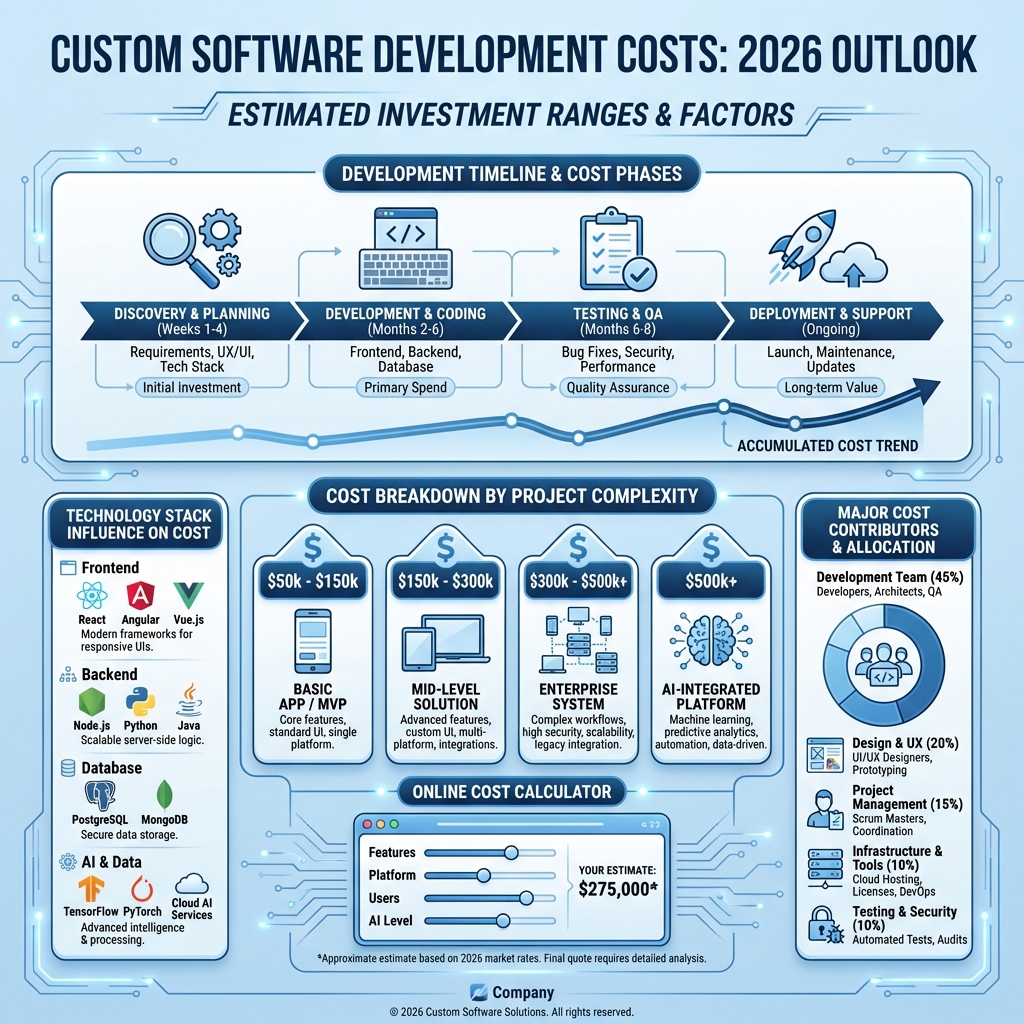
In 2026, businesses face a critical question when planning their digital transformation: how much will custom software development actually cost? The answer isn't straightforward, as pricing varies dramatically based on complexity, technology stack, team location, and project scope.
This comprehensive guide breaks down the real costs of custom software development in 2026, helping you budget effectively and avoid common pitfalls that can derail your project.
Executive Summary: Quick Cost Ranges
Before diving into details, here's what you can expect to invest in custom software development:
| Project Type | Cost Range | Timeline | Team Size |
|---|---|---|---|
| Basic MVP/App | $50,000 - $150,000 | 3-6 months | 3-5 people |
| Mid-Level System | $150,000 - $300,000 | 6-12 months | 5-8 people |
| Enterprise Solution | $300,000 - $500,000 | 12-18 months | 8-15 people |
| AI-Integrated Platform | $500,000+ | 18+ months | 15+ people |
1. Major Cost Factors in Software Development
1.1 Development Team Composition & Rates
Your development team is your largest expense. In 2026, hourly rates vary significantly by role and location:
- Senior Software Engineers: $100-$200/hour
- Mid-Level Developers: $70-$120/hour
- Junior Developers: $40-$70/hour
- UI/UX Designers: $80-$150/hour
- Project Managers: $90-$160/hour
- QA Engineers: $60-$100/hour
- DevOps Engineers: $100-$180/hour
- AI/ML Specialists: $150-$250/hour
Geographic Impact: Location dramatically affects costs. North American developers typically charge 2-3x more than equally skilled developers in Eastern Europe or Latin America, and 3-4x more than Asian markets.
1.2 Project Complexity & Features
Complexity is the primary cost driver. Here's how different features impact your budget:
Basic Features (Lower Cost):
- User authentication and profiles
- CRUD operations (Create, Read, Update, Delete)
- Simple dashboards and reporting
- Email notifications
- Basic search functionality
Advanced Features (Higher Cost):
- Real-time collaboration and messaging
- AI/ML integration and predictive analytics
- Complex workflow automation
- Multi-tenant architecture
- Advanced security and compliance (HIPAA, GDPR, SOC 2)
- Third-party API integrations (payment gateways, CRMs, etc.)
- Mobile app development (iOS + Android)
- Offline functionality and data synchronization
1.3 Technology Stack Selection
Your technology choices significantly impact both initial development costs and long-term maintenance:
Modern Stack (2026 Standard):
- Frontend: React, Vue.js, or Next.js
- Backend: Node.js, Python (Django/FastAPI), or Go
- Database: PostgreSQL, MongoDB, or cloud-native solutions
- Cloud Infrastructure: AWS, Azure, or Google Cloud
- AI/ML: TensorFlow, PyTorch, or OpenAI API
Cutting-edge technologies like AI integration can add 30-50% to development costs but may provide significant competitive advantages.
2. Hidden Costs You Must Consider
2.1 Infrastructure & Hosting
Cloud infrastructure costs are often underestimated. Budget for:
- Development Environment: $500-$2,000/month
- Staging Environment: $1,000-$3,000/month
- Production Environment: $2,000-$10,000+/month (scales with usage)
- CDN & Storage: $500-$5,000/month
- Monitoring & Logging: $200-$1,000/month
2.2 Third-Party Services & Licenses
Modern applications rely on numerous third-party services:
- Payment processing (Stripe, PayPal): 2.9% + $0.30 per transaction
- Email services (SendGrid, Mailgun): $100-$1,000/month
- SMS notifications (Twilio): $0.0075-$0.02 per message
- Analytics (Mixpanel, Amplitude): $0-$2,000/month
- Error tracking (Sentry): $26-$500/month
- AI APIs (OpenAI, Anthropic): $0.002-$0.06 per 1K tokens
2.3 Ongoing Maintenance & Support
Post-launch costs typically run 15-25% of initial development costs annually:
- Bug fixes and patches: 5-10% annually
- Security updates: 3-5% annually
- Feature enhancements: 7-10% annually
- Technical support: Variable based on SLA
3. Cost Breakdown by Development Phase
3.1 Discovery & Planning (10-15% of total cost)
This crucial phase includes:
- Requirements gathering and analysis
- Technical feasibility studies
- Architecture design
- Project roadmap creation
- Risk assessment
Typical cost: $15,000-$75,000 for a mid-sized project
3.2 Design (15-20% of total cost)
Comprehensive design work encompasses:
- User research and persona development
- Information architecture
- Wireframing and prototyping
- UI/UX design
- Design system creation
Typical cost: $22,500-$100,000
3.3 Development & Coding (50-60% of total cost)
The bulk of your investment goes here:
- Frontend development
- Backend development
- Database design and implementation
- API development
- Third-party integrations
- Security implementation
Typical cost: $75,000-$300,000
3.4 Testing & QA (10-15% of total cost)
Comprehensive testing includes:
- Unit testing
- Integration testing
- Performance testing
- Security testing
- User acceptance testing (UAT)
- Bug fixing
Typical cost: $15,000-$75,000
3.5 Deployment & Launch (5-10% of total cost)
Getting your software live involves:
- Infrastructure setup
- CI/CD pipeline configuration
- Data migration
- Performance optimization
- Launch support
Typical cost: $7,500-$50,000
4. How to Reduce Costs Without Sacrificing Quality
4.1 Start with an MVP
Launch with core features only, then iterate based on user feedback. This approach can reduce initial costs by 40-60% while validating your concept.
4.2 Choose the Right Development Partner
Consider nearshore or offshore development teams. A skilled team in Jordan, for example, can deliver the same quality as North American teams at 50-70% lower costs.
4.3 Leverage Modern Development Tools
Use low-code platforms for admin panels, pre-built UI component libraries, and cloud-native services to accelerate development.
4.4 Plan for Scalability from Day One
While it may seem counterintuitive, investing in scalable architecture upfront prevents costly rewrites later. Budget an extra 15-20% for proper architecture.
5. Real-World Examples: What You Get for Your Money
$75,000 Budget: Basic SaaS MVP
- User authentication and management
- Core feature set (3-5 main features)
- Responsive web application
- Basic admin dashboard
- Email notifications
- Payment integration
- 3-4 months development time
$200,000 Budget: Mid-Level Platform
- All MVP features plus:
- Advanced user roles and permissions
- Real-time features (chat, notifications)
- Mobile-responsive design
- Third-party integrations (5-7 services)
- Advanced analytics and reporting
- API for future mobile apps
- 6-9 months development time
$500,000+ Budget: Enterprise Solution
- All mid-level features plus:
- Native mobile apps (iOS + Android)
- AI/ML capabilities
- Advanced security and compliance
- Multi-tenant architecture
- Extensive third-party integrations
- Custom workflow automation
- White-label capabilities
- 12-18 months development time
6. Questions to Ask Before Committing
Before signing any contract, ensure you understand:
- What's included in the quoted price? (Design, development, testing, deployment?)
- What's the payment structure? (Milestone-based, hourly, fixed-price?)
- Who owns the intellectual property?
- What happens if requirements change?
- What's included in post-launch support?
- What are the infrastructure and hosting costs?
- How will communication be handled?
- What's the team's experience with similar projects?
Conclusion: Investing Wisely in Custom Software
Custom software development in 2026 represents a significant investment, typically ranging from $50,000 for basic MVPs to $500,000+ for enterprise solutions. However, the right software can transform your business, automate processes, and create competitive advantages worth many times the initial investment.
The key to success is thorough planning, choosing the right development partner, and maintaining realistic expectations about timelines and costs. Remember that the cheapest option rarely delivers the best value—focus on finding a team that understands your vision and has the expertise to execute it effectively.
Frequently Asked Questions
How long does custom software development take?
Timelines vary based on complexity: MVPs take 3-6 months, mid-level systems 6-12 months, and enterprise solutions 12-18+ months.
Should I hire in-house or outsource development?
Outsourcing is typically more cost-effective for one-time projects, while in-house teams make sense for ongoing development. Many companies use a hybrid approach.
What's the difference between fixed-price and time-and-materials contracts?
Fixed-price offers budget certainty but less flexibility. Time-and-materials provides more flexibility but requires careful scope management. For complex projects, time-and-materials with a cap often works best.
How much should I budget for maintenance?
Plan for 15-25% of initial development costs annually for maintenance, updates, and support.
Can I reduce costs by using offshore developers?
Yes, but choose carefully. Quality offshore teams can save 40-70% while maintaining quality, but poor communication and time zone differences can negate savings.