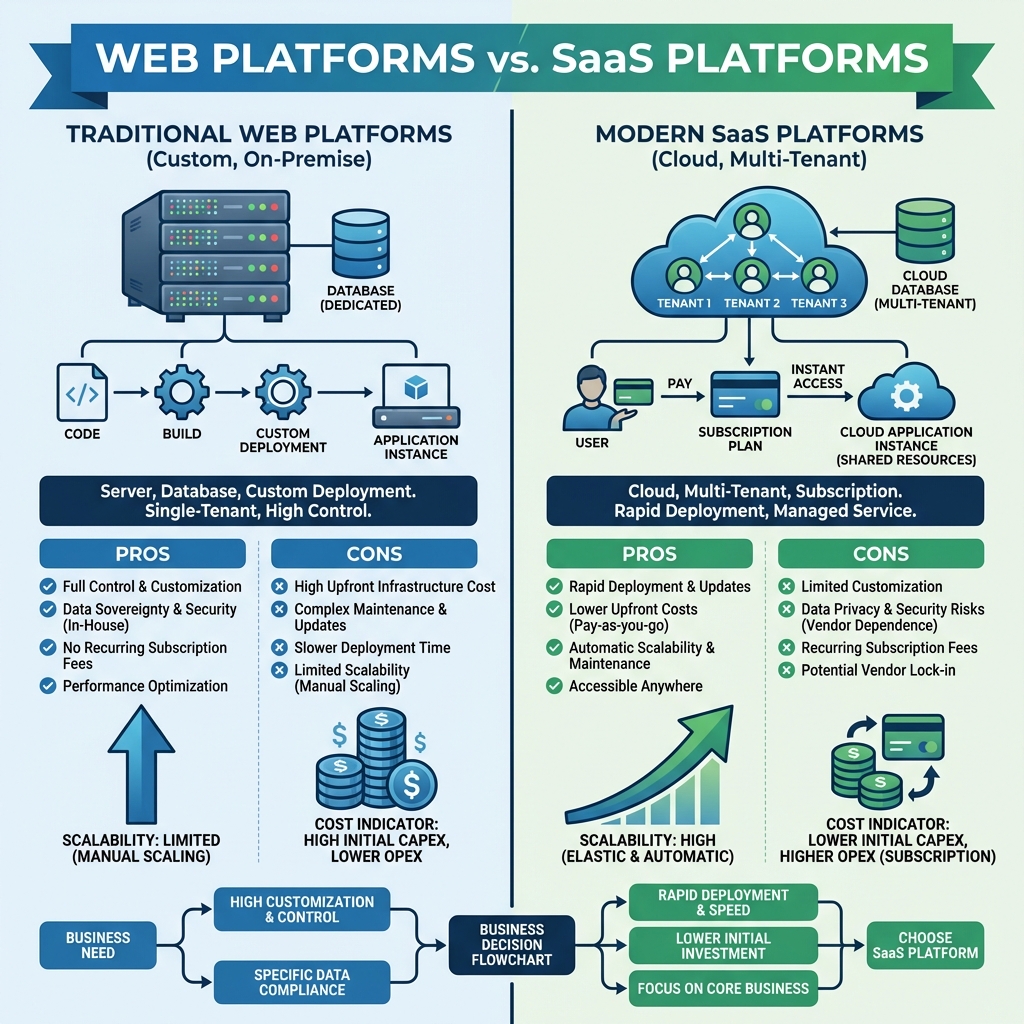
SaaS Development for Startups: The Complete 2026 Guide to Building and Scaling Your Product
From MVP to enterprise: everything you need to know about developing a successful SaaS product in 2026.
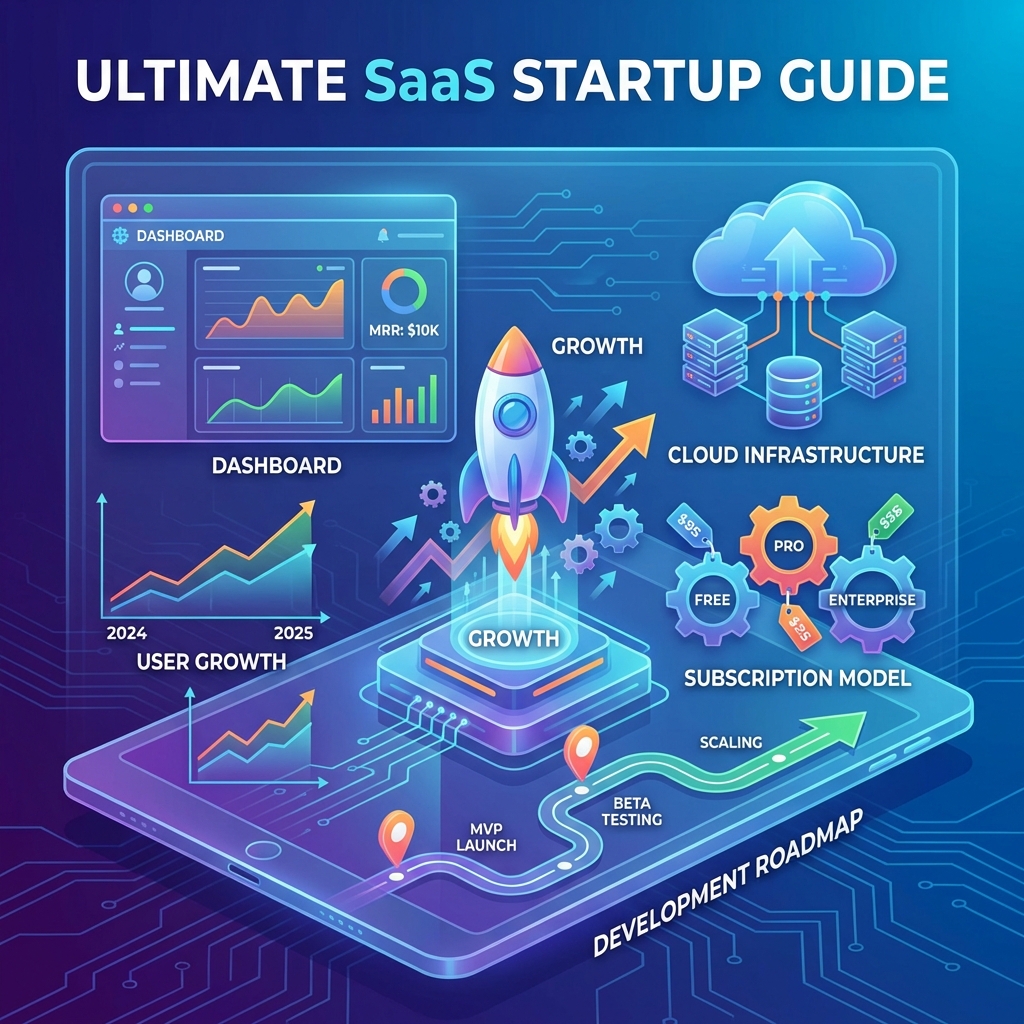
Building a Software-as-a-Service (SaaS) product is one of the most attractive paths for startups in 2026. With global SaaS revenue projected to reach $300 billion and businesses increasingly adopting cloud-based solutions, the opportunity has never been greater.
However, developing a successful SaaS product requires more than just a good idea. This comprehensive guide walks you through every stage of SaaS development—from initial concept to scaling for enterprise clients—providing actionable insights, cost breakdowns, and best practices learned from successful SaaS companies.
Why SaaS? The Business Model Advantage
Before diving into development, understand why SaaS is such a compelling model:
- Recurring Revenue: Predictable monthly/annual revenue streams
- Scalability: Serve thousands of customers with minimal incremental costs
- Lower Entry Barrier: Customers can try before committing to large purchases
- Continuous Improvement: Roll out updates instantly to all users
- Global Reach: Access customers worldwide without physical presence
- Data-Driven Insights: Track usage patterns and optimize continuously
- Higher Valuations: SaaS companies typically command higher multiples (8-12x ARR)
Phase 1: Planning Your SaaS Product (Weeks 1-4)
1.1 Market Research & Validation
Before writing a single line of code, validate your idea:
- Identify the Problem: What specific pain point are you solving?
- Define Your ICP: Who is your ideal customer profile?
- Analyze Competition: What alternatives exist? What's your unique value proposition?
- Assess Market Size: Is the market large enough to support your growth goals?
- Validate Willingness to Pay: Will customers actually pay for your solution?
Validation Methods:
- Conduct 20-30 customer interviews
- Create a landing page and measure interest (aim for 10%+ conversion)
- Offer pre-sales or beta access
- Build a waitlist (target: 100+ qualified leads)
- Test pricing with surveys
1.2 Define Your MVP Scope
Your Minimum Viable Product should include only essential features:
Essential MVP Features:
- User authentication and account management
- Core functionality that solves the primary problem
- Basic dashboard/interface
- Payment integration (if monetizing immediately)
- Essential security measures
- Basic analytics
1.3 Choose Your Pricing Model
Common SaaS pricing strategies:
- Freemium: Free tier with paid upgrades (Slack, Dropbox)
- Tiered Pricing: Multiple plans based on features/usage (HubSpot, Mailchimp)
- Per-User Pricing: Cost scales with team size (Zoom, Asana)
- Usage-Based: Pay for what you use (AWS, Twilio)
- Flat Rate: Single price for all features (Basecamp)
Pricing Best Practices:
- Start higher than you think—it's easier to lower prices than raise them
- Offer annual plans with 15-20% discount
- Include a free trial (7-14 days for B2C, 14-30 days for B2B)
- Make your pricing page transparent and easy to understand
- Consider value-based pricing tied to customer ROI
Phase 2: Technology Stack Selection (Week 5)
2.1 Modern SaaS Tech Stack (2026)
Frontend:
- Framework: React, Vue.js, or Next.js (for SEO)
- State Management: Redux, Zustand, or React Query
- UI Library: Tailwind CSS, Material-UI, or Chakra UI
- Build Tool: Vite or Webpack
Backend:
- Runtime: Node.js, Python (FastAPI/Django), or Go
- Framework: Express.js, NestJS, or FastAPI
- API: RESTful or GraphQL
- Authentication: JWT, OAuth 2.0, or Auth0
Database:
- Primary DB: PostgreSQL (most popular for SaaS)
- Caching: Redis
- Search: Elasticsearch or Algolia
- File Storage: AWS S3 or Cloudflare R2
Infrastructure:
- Cloud Provider: AWS, Google Cloud, or Azure
- Container: Docker
- Orchestration: Kubernetes (for scale) or Docker Compose (for MVP)
- CI/CD: GitHub Actions, GitLab CI, or CircleCI
Essential Services:
- Email: SendGrid, Postmark, or Amazon SES
- Payments: Stripe (most popular), Paddle, or Chargebee
- Analytics: Mixpanel, Amplitude, or PostHog
- Monitoring: Sentry, DataDog, or New Relic
- Customer Support: Intercom, Zendesk, or Help Scout
2.2 Architecture Decisions
Monolith vs Microservices:
For MVP and early-stage startups, start with a modular monolith:
- Faster development and deployment
- Easier to debug and maintain
- Lower infrastructure costs
- Can be split into microservices later if needed
Multi-Tenancy Strategy:
Choose between:
- Shared Database, Shared Schema: Most cost-effective, suitable for B2C
- Shared Database, Separate Schemas: Better isolation, good for B2B
- Separate Databases: Maximum isolation, required for enterprise/compliance
Phase 3: MVP Development (Weeks 6-18)
3.1 Development Timeline
Typical 12-week MVP development schedule:
- Weeks 1-2: Project setup, architecture, database design
- Weeks 3-4: Authentication, user management, basic UI
- Weeks 5-8: Core feature development
- Weeks 9-10: Payment integration, billing logic
- Weeks 11-12: Testing, bug fixes, polish
3.2 Development Best Practices
- Write Clean Code: Follow SOLID principles and design patterns
- Implement Testing: Unit tests (70%+ coverage), integration tests, E2E tests
- Use Version Control: Git with feature branches and pull requests
- Document Everything: API docs, architecture decisions, setup guides
- Security First: HTTPS, input validation, SQL injection prevention, XSS protection
- Performance Optimization: Database indexing, caching, lazy loading
3.3 Security & Compliance
Essential security measures for SaaS:
- Data Encryption: At rest (AES-256) and in transit (TLS 1.3)
- Access Control: Role-based access control (RBAC)
- Regular Backups: Automated daily backups with point-in-time recovery
- Audit Logging: Track all critical actions
- Penetration Testing: Annual security audits
- Compliance: GDPR, SOC 2, HIPAA (if applicable)
Phase 4: Launch Preparation (Weeks 19-22)
4.1 Beta Testing
Run a structured beta program:
- Recruit Beta Users: 20-50 users from your target market
- Set Clear Expectations: What you're testing and timeline
- Gather Feedback: Weekly surveys, usage analytics, interviews
- Iterate Quickly: Fix critical bugs, refine UX
- Measure Key Metrics: Activation rate, feature usage, retention
4.2 Launch Checklist
Pre-Launch Essentials:
- All critical bugs fixed
- Payment processing tested and working
- Email templates created and tested
- Terms of Service and Privacy Policy published
- Help documentation and FAQs created
- Customer support system set up
- Analytics and monitoring configured
- Backup and disaster recovery tested
- Performance tested under load
- Security audit completed
4.3 Marketing & Go-to-Market
Launch strategy for SaaS startups:
- Product Hunt Launch: Prepare for launch day, engage with community
- Content Marketing: Blog posts, case studies, tutorials
- SEO Optimization: Target long-tail keywords, create landing pages
- Email Marketing: Nurture your waitlist, onboarding sequences
- Paid Advertising: Google Ads, LinkedIn Ads (B2B), Facebook Ads (B2C)
- Partnerships: Integration partners, affiliate programs
- Community Building: Slack/Discord community, user forums
Phase 5: Growth & Scaling (Months 6-24)
5.1 Key SaaS Metrics to Track
Revenue Metrics:
- MRR/ARR: Monthly/Annual Recurring Revenue
- ARPU: Average Revenue Per User
- LTV: Customer Lifetime Value
- CAC: Customer Acquisition Cost (target: LTV/CAC > 3)
Growth Metrics:
- User Growth Rate: Month-over-month growth
- Activation Rate: % of signups who complete key action
- Conversion Rate: Free trial to paid conversion
- Expansion Revenue: Upsells and cross-sells
Retention Metrics:
- Churn Rate: % of customers who cancel (target: <5% monthly)
- Net Revenue Retention: Revenue retention including expansion (target: >100%)
- Cohort Analysis: Track retention by signup cohort
5.2 Scaling Infrastructure
As you grow, optimize for scale:
- Database Optimization:
- Implement read replicas
- Use connection pooling
- Add database sharding if needed
- Optimize slow queries
- Caching Strategy:
- Application-level caching (Redis)
- CDN for static assets
- API response caching
- Database query caching
- Load Balancing:
- Horizontal scaling with load balancers
- Auto-scaling based on traffic
- Geographic distribution (multi-region)
- Monitoring & Alerting:
- Real-time performance monitoring
- Error tracking and alerting
- Uptime monitoring (target: 99.9%+)
- Cost monitoring and optimization
5.3 Building for Enterprise
To move upmarket, add enterprise features:
- SSO & Advanced Auth: SAML, Active Directory integration
- Advanced Permissions: Granular role-based access control
- Audit Logs: Comprehensive activity tracking
- SLA Guarantees: 99.9%+ uptime commitments
- Dedicated Support: Account managers, priority support
- Custom Contracts: Flexible terms, annual billing
- Compliance Certifications: SOC 2, ISO 27001, HIPAA
- Data Residency: Region-specific data storage
Cost Breakdown: Building a SaaS Product
MVP Development Costs (3-6 months)
- Development Team: $75,000-$150,000
- 2 Full-stack developers
- 1 UI/UX designer
- 1 Project manager (part-time)
- Infrastructure: $2,000-$5,000
- Cloud hosting (AWS/GCP)
- Development and staging environments
- Third-Party Services: $3,000-$8,000
- Payment processing setup
- Email service
- Analytics tools
- Monitoring and logging
- Legal & Compliance: $5,000-$15,000
- Terms of Service
- Privacy Policy
- Legal entity setup
Total MVP Cost: $85,000-$178,000
Ongoing Monthly Costs (Post-Launch)
- Infrastructure: $1,000-$5,000 (scales with users)
- Third-Party Services: $500-$2,000
- Customer Support: $2,000-$5,000
- Marketing: $3,000-$10,000
- Development (ongoing): $10,000-$25,000
Total Monthly: $16,500-$47,000
Common Pitfalls to Avoid
- Building in Isolation: Talk to customers throughout development
- Over-Engineering: Don't build for scale you don't have yet
- Ignoring Security: Security breaches can kill your startup
- Poor Onboarding: 40-60% of users never return after first visit
- Underpricing: Charge based on value, not cost
- Neglecting Metrics: You can't improve what you don't measure
- Premature Scaling: Achieve product-market fit before scaling
- Technical Debt: Balance speed with code quality
Success Stories: SaaS Startups That Made It
Slack: From Side Project to $27B Acquisition
- Started as internal tool for gaming company
- Launched with freemium model
- Focused on viral growth through team invites
- Reached $1M ARR in 6 months
- Acquired by Salesforce for $27.7B
Calendly: Bootstrapped to $3B Valuation
- Built by solo founder with $200K savings
- Solved simple problem: scheduling meetings
- Freemium model with viral growth
- Reached profitability before raising funding
- Valued at $3B in 2021
Conclusion: Your SaaS Journey Starts Here
Building a successful SaaS product in 2026 requires careful planning, the right technology choices, and a relentless focus on customer value. While the journey is challenging, the potential rewards—recurring revenue, scalability, and the ability to serve customers globally—make it one of the most attractive business models for startups.
Remember: start small with an MVP, validate with real customers, iterate based on feedback, and scale systematically. The most successful SaaS companies didn't try to build everything at once—they focused on solving one problem exceptionally well, then expanded from there.
With the right approach, development partner, and execution, your SaaS startup can join the ranks of successful companies transforming industries through cloud-based software.
Frequently Asked Questions
How long does it take to build a SaaS MVP?
A typical SaaS MVP takes 3-6 months to build with a small team. Complex products may take 6-9 months, while simple tools can be built in 2-3 months.
Should I build in-house or outsource SaaS development?
For non-technical founders, outsourcing to an experienced SaaS development company is often faster and more cost-effective. Once you have revenue, you can build an in-house team.
What's the best pricing model for a new SaaS product?
Tiered pricing (3-4 plans) works well for most SaaS products. Include a free trial, and consider a limited free tier to drive adoption.
How much should I charge for my SaaS product?
Price based on value delivered, not cost. Research competitors, but don't be afraid to charge more if you provide superior value. B2B SaaS typically ranges from $50-$500/month per user.
When should I start worrying about scalability?
Build for moderate scale from the start (good architecture, caching, database indexing), but don't over-engineer. Most scalability issues can be solved when you have revenue and users.